












India’s space sector is undergoing a major transformation, with private participation, indigenous technologies, commercialisation and international partnerships driving rapid expansion.
According to a Jefferies report, India’s space economy, currently valued at around US$8 billion, is targeted to expand nearly fivefold to US$40-45 billion by 2030, increasing the country’s share of the global space economy to around 8 per cent. The government has also set a longer-term ambition of building a US$100-billion space economy by 2040.
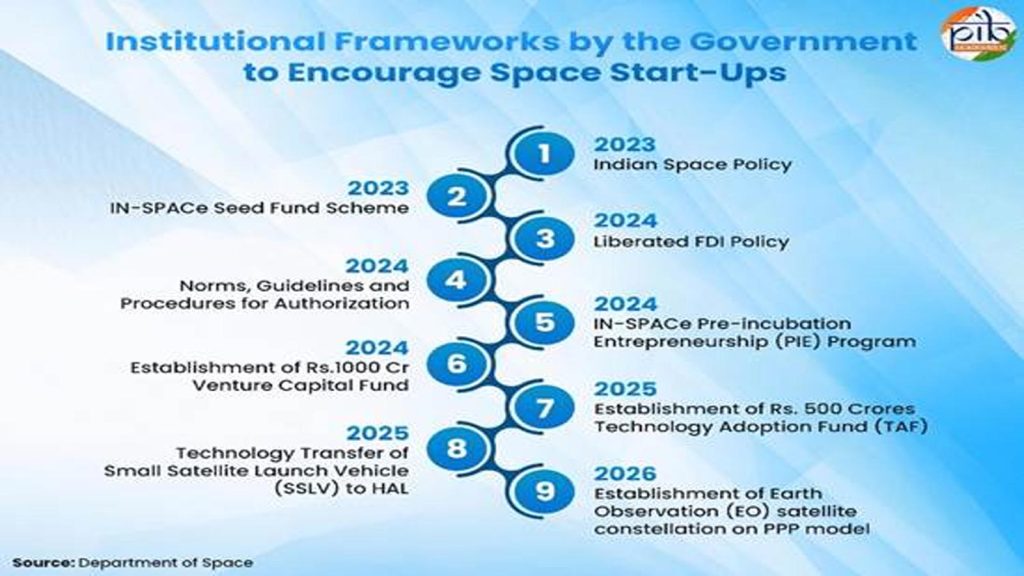
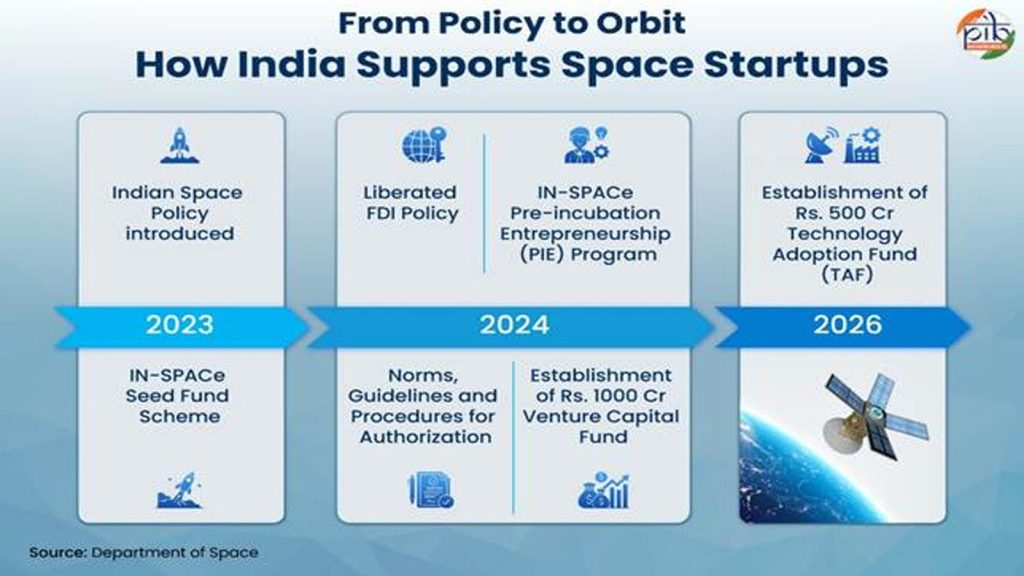
The sector opened to private participation in 2020, followed by the Indian Space Policy 2023 and liberalised foreign direct investment (FDI) rules. India now has more than 400 space startups, compared with just one in 2014.
Companies such as Skyroot Aerospace, Pixxel, Agnikul Cosmos and Dhruva Space are developing launch vehicles, satellites, Earth-observation systems and other space technologies. Skyroot’s Vikram-1, India’s first privately developed orbital rocket, is designed to place up to 350 kg into Low Earth Orbit.
The government has also introduced funding mechanisms to strengthen the private ecosystem, including the ₹1,000-crore Venture Capital Fund, an IN-SPACe Seed Fund offering support of up to ₹1 crore, and a ₹500-crore Technology Adoption Fund.
Expanding scientific and human spaceflight capabilities
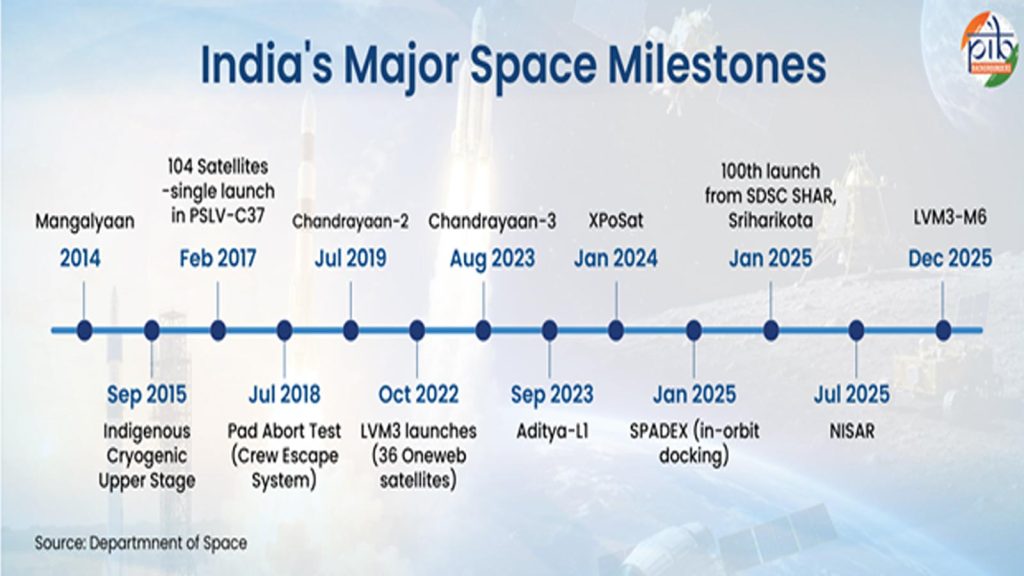
India’s space programme has expanded from satellite launches to complex lunar, solar and human-spaceflight missions. Chandrayaan-3 achieved the first soft landing near the Moon’s south pole in August 2023. Chandrayaan-4, planned for 2027, will pursue lunar sample return, while the LUPEX mission with Japan will explore water and volatile materials near the lunar south pole.
The SpaDeX mission demonstrated autonomous docking and undocking in January 2025, strengthening capabilities required for future complex missions.
India is also preparing for Gaganyaan, which aims to send up to three astronauts into a 400-km orbit for up to three days. The planned Bharatiya Antariksh Station, with its first module targeted by 2028, is expected to support long-duration human missions and microgravity research.
Commercial and global footprint grows
Commercialisation is gaining momentum through NewSpace India Limited (NSIL), whose revenue rose from ₹321.77 crore in FY2021–22 to ₹3,246.09 crore in FY2024–25.
India has signed more than 300 space cooperation agreements with 61 countries and five multilateral organisations. Missions such as NISAR with NASA and LUPEX with Japan underline the country’s growing role in global space cooperation.
With expanding launch infrastructure, reusable technologies and a growing private ecosystem, India is seeking to evolve from a spacefaring nation into a major global space industry hub.












