








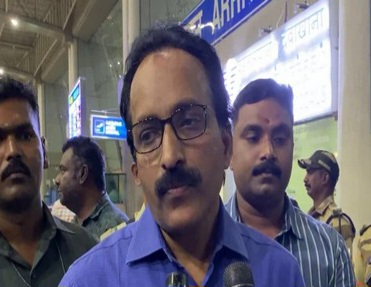
Indian Space and Research Organisation (ISRO) Chief S Somnath on Sunday said that India's first solar mission, Aditya-L1 spacecraft will reach the Lagrange Point 1 (L1) by mid-January.
“It is working very well… Currently, it takes almost 110 days to travel from Earth to the L1 point. So by the middle of January, it will reach the L1 point. Then at that point, we will do the insertion into the Lagrange Point. That is called the halo orbit. It's a big orbit. So that will happen by the middle of January”, Somath said to a source.
This update follows the successful soft landing of Chandrayaan-3 near the South pole of the Moon, leading to the subsequent launch of India's first solar mission, Aditya-L1, from the Satish Dhawan Space Centre in Sriharikota on September 2. Aditya-L1 is equipped with seven unique payloads designed for an extensive study of the Sun. Four of these payloads are designed to monitor solar light, while the remaining three will collect in-situ data on plasma and magnetic field parameters.
Aditya-L1's intended orbit is a halo orbit positioned around Lagrangian Point 1 (L1), which is located 1.5 million kilometers away from Earth, in the direction of the Sun. The spacecraft is projected to traverse this extensive distance within a four-month timeframe, maintaining an approximate distance of 1.5 million kilometers from Earth while continually facing the Sun. It is crucial to note that Aditya-L1's mission is exclusively focused on studying the outer atmosphere of the Sun, with no intentions of landing on or approaching the Sun closely.
Additionally, Chief Somnath also discussed the 'Gaganyaan' mission, revealing plans for the Test Vehicle-D1 mission scheduled for October 21. This mission holds a pivotal role within the Gaganyaan program, serving as a demonstration of the crew escape system's functionality, a critical safety measure in the event of rocket malfunctions, specifically during a Transonic condition.
ISRO has set an ambitious launch schedule, targeting at least one launch each month. This agenda includes launches of GSLV and SSLV, with the forthcoming Gaganyaan unmanned mission on the horizon. There is also a scheduled PSLV launch in between these missions. With these operations, ISRO is preparing for a series of 4-5 launches prior to January.
The Gaganyaan project, as defined by ISRO, is aimed at showcasing India's human spaceflight capabilities by deploying a three-member crew into a 400 km orbit for a three-day mission, ensuring their safe return through a landing in the Indian sea waters.
(Inputs from ANI)