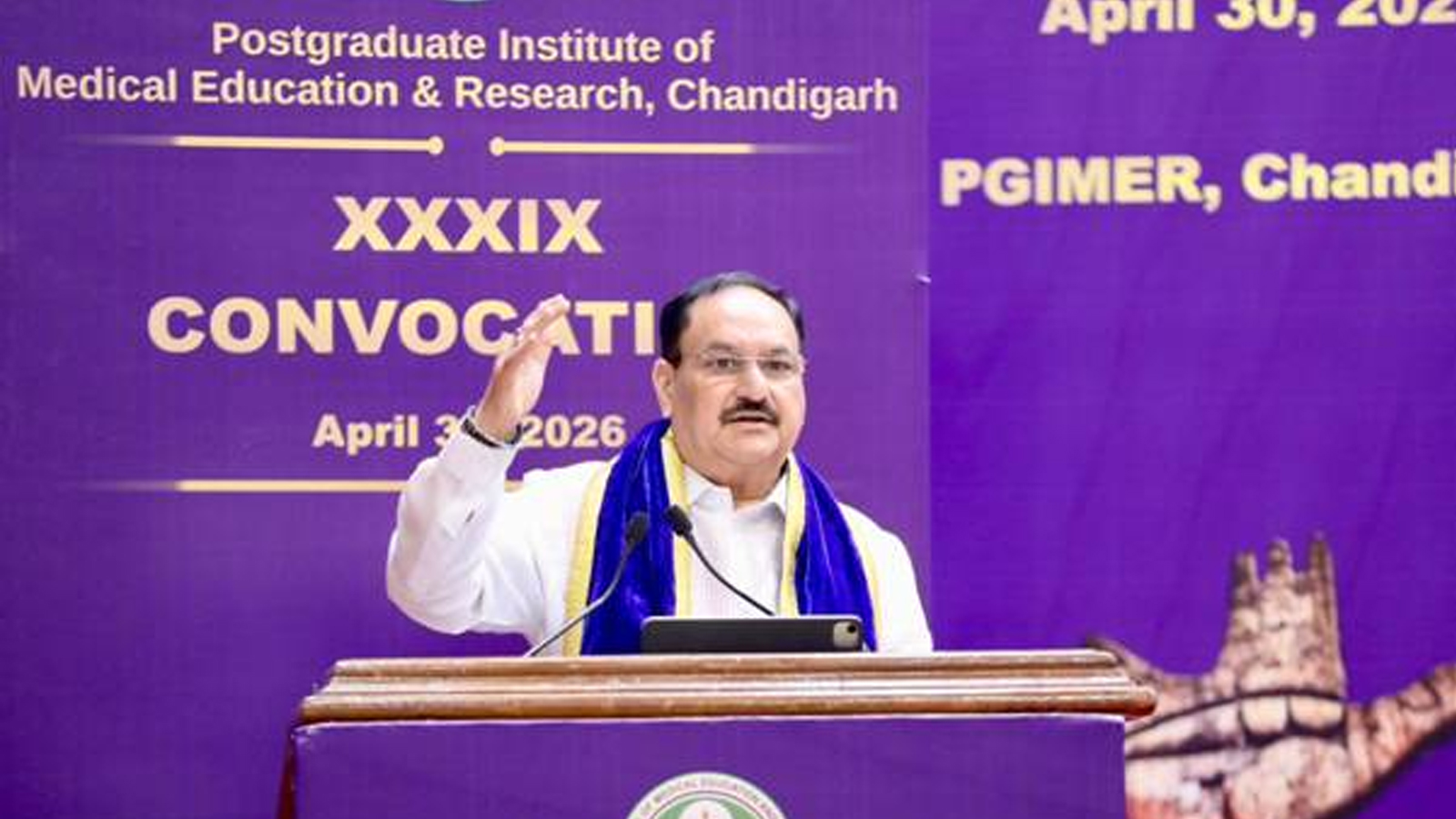
Union Health Minister Jagat Prakash Nadda on Thursday underscored India’s rapid expansion in healthcare infrastructure while addressing the 39th convocation of the Postgraduate Institute of Medical Education and Research (PGIMER), Chandigarh where 682 graduates were conferred degrees.
Speaking at the ceremony, Nadda highlighted the transformation in India’s medical education ecosystem over the past decade, noting that the number of AIIMS institutions has risen to 23, while medical colleges have increased from 387 to 818. He added that total medical seats have crossed two lakh, reflecting a significant push to strengthen the country’s healthcare capacity.
The convocation saw 61 PhD scholars, 114 DM candidates, along with MD, MS, MCh, and MDS graduates receive degrees, while 95 medals were awarded for academic excellence.
Describing PGIMER as one of North India’s largest public healthcare ecosystems, the Minister praised its legacy in delivering world-class patient care, medical education, and research. He noted that the institute has built a strong reputation through decades of pioneering clinical work, including complex transplant procedures such as kidney, liver, and simultaneous pancreas-kidney transplants.
“PGI Chandigarh is not just an institute but a centre of excellence that has contributed immensely to advancing medical science and healthcare delivery in India,” Nadda said, commending its robust research ecosystem with hundreds of ongoing projects.
Highlighting broader healthcare reforms, the Minister said India has shifted towards a more holistic healthcare model, combining preventive, promotive, curative, and palliative care. He credited policy initiatives under Prime Minister Narendra Modi for driving expansion in tertiary healthcare and medical education.
Nadda also pointed out the significant public investment in medical education, stating that the government spends approximately ₹30–35 lakh per student annually, with additional funding approved to expand seats in government medical colleges.
Looking ahead, he emphasised the growing role of emerging technologies such as artificial intelligence, gene therapy, and precision medicine in transforming healthcare, while urging graduates to maintain compassion as a core value in medical practice.
“Technology will shape the future of healthcare, but the human touch must remain central,” he said, encouraging students to balance innovation with empathy.
The event was attended by Gulab Chand Kataria, Governor of Punjab and Administrator of Chandigarh, and Vinod K. Paul, along with senior officials and faculty members.
Established in 1962, PGIMER Chandigarh remains one of India’s premier medical institutions, handling millions of patients annually and maintaining a leading position in clinical care, research, and medical training.