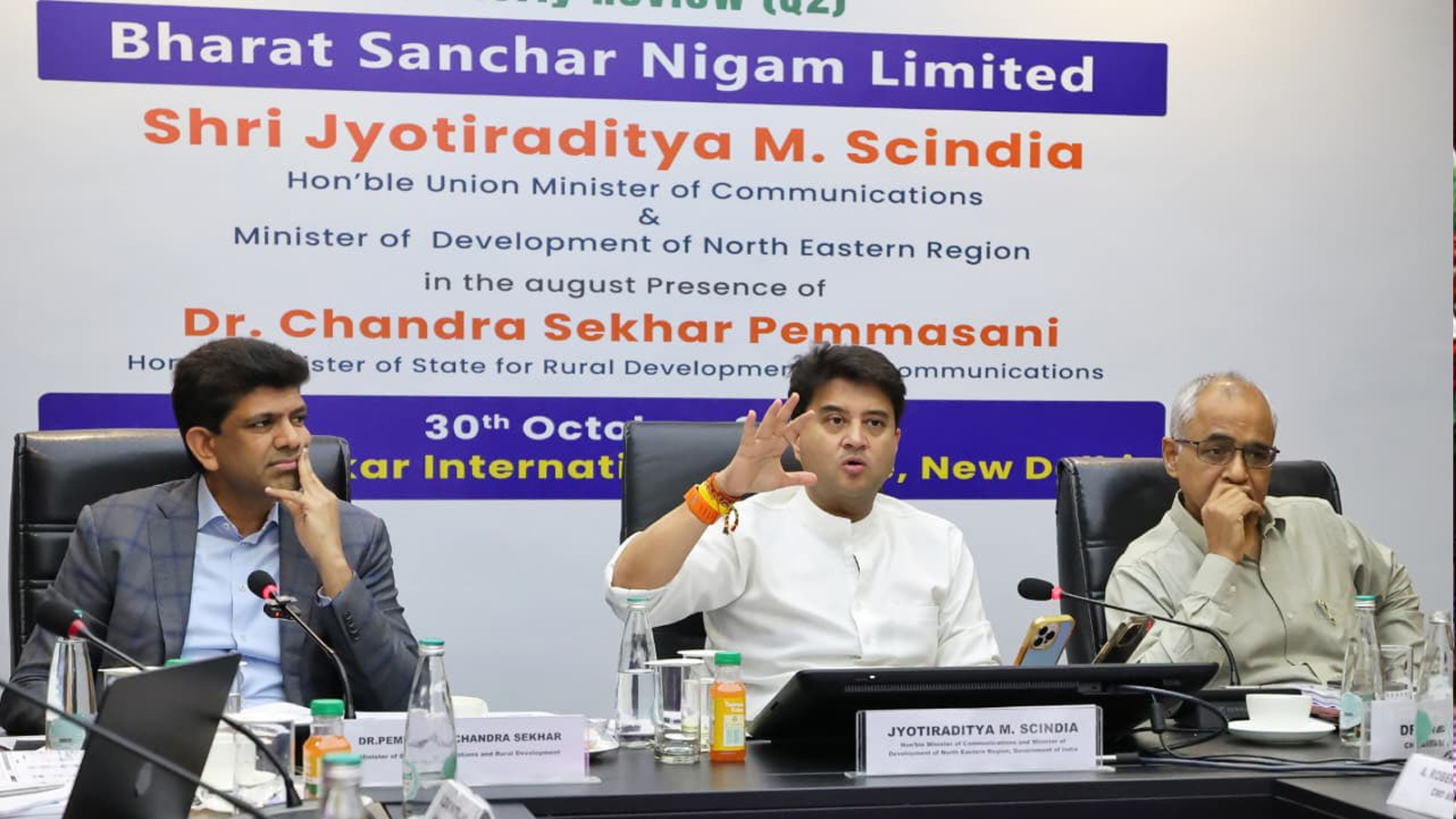
Union Minister for Communications and Development of the North Eastern Region, Jyotiraditya M. Scindia, on Thursday chaired the Quarter 2 (2025–26) Strategic Review and Planning Meeting of Bharat Sanchar Nigam Limited (BSNL) in New Delhi. The meeting, attended by Minister of State for Rural Development and Communications Dr. Chandra Sekhar Pemmasani, Secretary (Telecommunications) Dr. Neeraj Mittal, Additional Secretary Gulzar Natarajan, senior DoT officials, and BSNL’s Chief General Managers (CGMs) from across all 28 circles, focused on sustaining BSNL’s profitability momentum and strengthening its operational efficiency.
The four-hour-long review assessed circle-wise and vertical-wise performance across key parameters such as revenue, service quality, and customer experience. It also laid down a roadmap for BSNL’s continued transformation into a future-ready, performance-driven telecom enterprise.
During the review, Scindia noted that BSNL achieved a 93% revenue run rate in Q2 FY 2025–26, generating ₹5,347 crore against a target of ₹5,740 crore. Combined with Q1 revenues of ₹6,000 crore, BSNL recorded ₹11,134 crore in total revenues for the first half of the fiscal year. The company is targeting ₹27,500 crore in annual revenue for FY 2025–26, up from ₹25,000 crore in the previous year.
The Minister commended BSNL’s leadership team for maintaining growth momentum following the organization’s historic back-to-back quarterly net profits in FY 2024–25.
He highlighted that Average Revenue Per User (ARPU) increased from ₹81 in Q1 to ₹91 in Q2, a 12% improvement, with Maharashtra (₹214 ARPU), Kerala (+30%), and UP (West) (+13%) leading in performance. However, he urged circles like Madhya Pradesh, Jharkhand, and Kolkata to improve their sub-₹60 ARPU levels.
The average revenue per employee was reported at ₹9 lakh, with standout performances from Odisha (₹22 lakh), Chhattisgarh (₹19 lakh), Maharashtra (₹14 lakh), and Haryana (₹15 lakh).
Among BSNL’s business verticals, Enterprise Business (EB) surpassed its quarterly target at 103% (₹1,272 crore), while Consumer Fixed Access (CFA) achieved 90% (₹722 crore), and Consumer Mobility reached 75% (₹1,700 crore) with 9.23 crore subscribers and 5.4 lakh new additions in the last month.
Scindia outlined a seven-point action plan for all CGMs to follow in the upcoming quarters:
* Quality of Service (QoS) must remain non-negotiable, with parameters such as uptime, mean repair time, and customer satisfaction tracked daily.
* Circles must conduct competitor analysis on network and service parameters to identify and close performance gaps.
* Battery and media replacements across all circles to be completed by December 31, 2025, with execution timelines measured in days and hours, not months.
* Maintain cost discipline, ensuring no circle reports negative EBITDA — every rupee saved contributes directly to profitability.
* Develop new revenue streams across Consumer Mobility, Enterprise Business, and Fixed Access through innovation.
* Strive for a 50:50 revenue split between government and private clients by the next fiscal year.
* Strengthen circle-level leadership, promoting teamwork, accountability, and a culture of ownership.
“Culture Outweighs Strategy” – Leadership and Empowerment
The Minister emphasized that BSNL’s success lies in its people, noting, “Everything in life is execution-driven, and our CGMs are BSNL’s execution artists. You are the standard-bearers of transformation across your circles.”
He stressed the importance of a leadership culture rooted in ownership and empowerment, encouraging CGMs to replicate the quarterly and monthly review model at the circle, business area, and operational levels, engaging over 400 officers per circle in structured review and mentoring sessions.
“Your teams are not just employees; they are your family,” Scindia said, underscoring that organizational culture ultimately outweighs strategy – once the right culture is instilled, the system drives itself.
The Minister commended Karnataka, Haryana, Uttar Pradesh (East), Jammu & Kashmir, and Andaman & Nicobar circles for their outstanding performance, calling them BSNL’s “five stars.” He encouraged other circles to emulate their leadership and operational models, saying he hoped these “five stars” would be “challenged and unseated in Q3 by others aiming higher.”
Concluding the session, Scindia reaffirmed BSNL’s commitment to customer-centric transformation, financial prudence, and operational excellence. He also urged the company to continue exploring new business opportunities and innovative offerings, citing India Post’s upcoming launch of six new products in early 2026 as an example of public-sector innovation.
The meeting ended with a collective pledge by all circles to strengthen BSNL’s position as a profitable, efficient, and customer-driven telecom enterprise, ensuring sustained growth through FY 2025-26 and beyond.