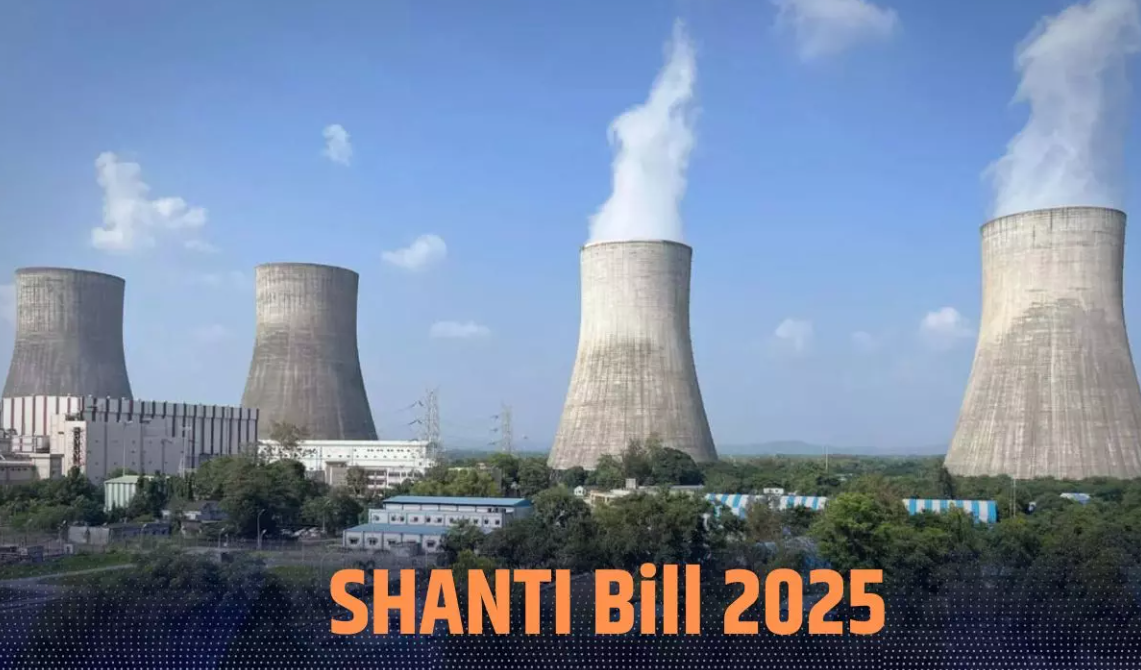
India has taken a significant legislative step towards reshaping its nuclear energy landscape with the Sustainable Harnessing and Advancement of Nuclear Energy for Transforming India (SHANTI) Bill, 2025. The law consolidates and modernises India’s nuclear legal framework, enables limited private participation under strict regulatory oversight, and strengthens institutional governance by granting statutory status to the Atomic Energy Regulatory Board (AERB).
The Bill also aligns with India’s long-term clean energy ambitions, including the goal of achieving 100 GW of nuclear power capacity by 2047.
Understanding nuclear energy
Nuclear energy is generated through controlled atomic reactions, primarily nuclear fission, in which atoms are split to release large amounts of heat. This heat is used to produce electricity without emitting greenhouse gases. Globally, nuclear power is regarded as a reliable and low-carbon energy source that complements renewables such as solar and wind, especially by providing stable, round-the-clock electricity.
As India reimagines its future energy mix, nuclear power is increasingly viewed as a critical pillar for ensuring energy security, meeting climate commitments, and supporting high-growth sectors such as data centres and advanced manufacturing.
Evolution of India’s nuclear legal framework
India’s nuclear journey has been guided by carefully structured legislation aimed at peaceful use, safety, and strategic control. The Atomic Energy Act, 1962, replaced the earlier 1948 law and laid the foundation for the country’s nuclear programme, placing atomic energy firmly under government regulation.
Subsequent amendments in 1986, 1987 and 2015 gradually expanded participation beyond the Central Government, allowing government companies and joint ventures to engage in nuclear power generation while preserving sovereign oversight.
The Civil Liability for Nuclear Damage Act, 2010, further strengthened the framework by introducing a no-fault liability regime to ensure compensation in the event of nuclear incidents, reinforcing public trust and accountability.
Rationale behind the SHANTI Bill
With India’s nuclear programme maturing and clean-energy goals expanding, the existing legal structure is increasingly seen as fragmented and outdated. The SHANTI Bill responds to the need for a unified, future-ready legislation that reflects technological progress, growing capacity ambitions, and the need for regulatory clarity.
The Bill seeks to replace multiple legacy laws with a comprehensive framework that supports expansion while maintaining the highest standards of safety, security, safeguards, and liability.
India’s present nuclear outlook
Nuclear energy currently contributes a stable share to India’s electricity mix, accounting for around 3% of total generation, with a 3.1% share in 2024–25. Installed nuclear capacity stands at 8.78 GW.
With indigenous 700 MW reactors and 1,000 MW units developed through international cooperation, capacity is projected to rise to 22.38 GW by 2031–32, signalling a phase of accelerated growth.
Nuclear Energy Mission and SMR push
The Union Budget 2025–26 announced a dedicated Nuclear Energy Mission with an allocation of ₹20,000 crore to support the design, development and deployment of Small Modular Reactors (SMRs). The target is to operationalise at least five indigenously designed SMRs by 2033.
Key initiatives by the Bhabha Atomic Research Centre include the 200 MWe Bharat Small Modular Reactor (BSMR-200), the SMR-55, and a high-temperature gas-cooled reactor of up to 5 MW thermal capacity for hydrogen generation. The long-term objective remains achieving 100 GW of nuclear capacity by 2047.
Why scaling nuclear power is critical
India’s growing electricity demand and decarbonisation targets make nuclear expansion essential. Existing laws, however, lack the flexibility and speed required to meet future needs. A modern legal framework is necessary to enable wider participation, promote innovation, and integrate safety with growth.
The SHANTI Bill addresses these challenges by creating a unified legislative base that supports power generation, non-power applications, and advanced technologies while preserving strategic control.
Key features of the SHANTI Bill
The Bill allows limited private sector participation in nuclear plant operations, power generation, equipment manufacturing, and selected fuel-cycle activities, subject to regulatory approvals. All radiation-related activities require prior safety authorisation.
Sensitive fuel-cycle operations, including enrichment, spent fuel management, heavy water production, and high-level waste handling, remain exclusively under Central Government control.
The legislation introduces a structured licensing system, a graded liability framework linked to the nature of installations, and a balanced civil liability regime for nuclear damage.
It also establishes regulation for non-power applications in healthcare, agriculture, industry and research, while allowing exemptions for limited research and innovation activities.
Institutional strengthening and oversight
A key reform is granting statutory recognition to the Atomic Energy Regulatory Board, reinforcing its independence and authority. The Bill also enhances safety, security, safeguards, and emergency preparedness mechanisms.
Dispute resolution is addressed through the creation of an Atomic Energy Redressal Advisory Council, with the Appellate Tribunal for Electricity designated as the appellate authority. Provisions are also made for Claims Commissioners and a Nuclear Damage Claims Commission to handle compensation cases.
Safeguards and strategic control
Despite opening the sector to private participation, the Bill ensures that strategic autonomy remains intact. The government retains exclusive authority over critical domains, including fuel-cycle activities, waste management, and security-related operations, ensuring national interests are fully protected.
The SHANTI Bill, 2025, marks a defining moment in India’s nuclear energy evolution. By modernising the legal framework, strengthening regulatory institutions, and enabling controlled expansion, it lays the foundation for a secure, innovative and sustainable nuclear ecosystem. As India moves toward greater energy independence and long-term decarbonisation, the legislation is poised to play a central role in shaping the country’s clean-energy future.