







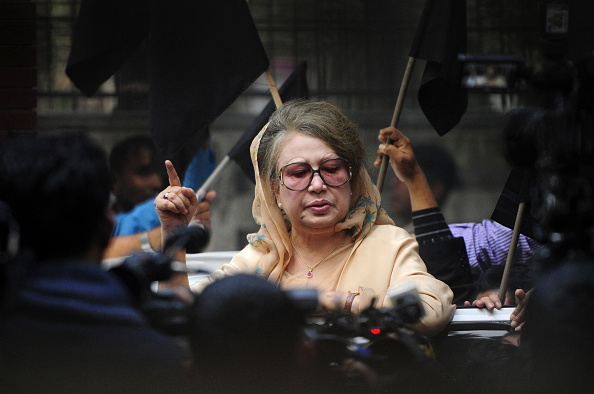
Bangladesh’s first female leader Khaleda Zia was freed from house arrest on Tuesday, a day after her nemesis Sheikh Hasina quit as premier and fled,one more twist to the decades-old saga of the “Battle of the Begums” for control of Bangladesh.
President Mohammed Shahabuddin’s office said that Khaleda, chief of the main opposition Bangladesh Nationalist Party, had been freedafter discussions with defence chiefs and politicians.
Between them, Hasina, 76, and Khaleda, 78, have dominated the country since 1991, alternating in power after inheriting the political movements of two assassinated rulers who led Bangladesh in its first decade.
Sheikh Hasina led the Awami League of her father, state founder Mujibur Rahman, who was assassinated in 1975. Khaleda took over the BNP from her husband Ziaur Rahman, killed in 1981.
Their feud, known as the “Battle of the Begums” using the South Asian honorific for a woman of high rank, has loomed over Bangladeshi politics for decades.
Since Hasina emerged victorious in 2009, Khaleda had faced an array of criminal charges and jail, receding from public life and leaving her exiled eldest son in charge as acting leader of her political movement.
Born on Aug. 15, 1945, she now has liver disease, diabetes and heart problems, according to her doctors.
Popularly known by her first name, Khaleda was widely seen as a shy wife and devoted mother until her husband was assassinated in an attempted army coup in 1981.
Plunging into politics, she became head of her husband’s conservative BNP three years later, vowing to deliver on his aim of “liberating Bangladesh from poverty and economic backwardness”.
She and Hasina joined hands to lead a popular uprising for democracy that toppled military ruler Hossain Mohammad Ershad from power in 1990. But political rivalry embittered the relationship, fuelling a feud ever since.
In 1991 Bangladesh held what was hailed as its first free election. Khaleda won a surprise victory over Hasina, having gained the support of Islamic political allies.
In doing so, she became Bangladesh’s first female prime minister, only the second woman to lead a democratic government of a mainly Muslim nation after Pakistan’s Benazir Bhutto.
She replaced the presidential system with a parliamentary form of government so that power rested with the prime minister, lifted restrictions on foreign investment and made primary education compulsory and free.
She lost to Hasina in a 1996 election, then returned to power in another election five years later. Her second term was marred by the rise of Islamist militants and allegations of corruption.
In 2004, a rally that Hasina was addressing was hit by grenades. Hasina survived but over 20 people were killed and more than 500 were wounded. Khaleda’s government and its Islamic allies were widely blamed, and years later Khaleda’s eldest son was tried in absentia and sentenced to life for the attack. The BNP contended the charges were trumped up.
Although Khaleda later clamped down on Islamist radical groups, her second stint as prime minister ended in 2006 when an army-backed interim government took power amid political instability and street violence.
The interim government jailed both Khaleda and Hasina on charges of corruption and abuse of power for about a year before they were both released ahead of a general election in 2008.
Although the BNP boycotted the 2008 election and Khaleda never regained power, her vitriolic feud with Hasina continued to dominate Bangladeshi politics.
Tension between their two parties has often led to strikes, violence and deaths, impeding economic development for a poverty-stricken country of nearly 170 million that is low-lying and prone to devastating floods.
In 2018, Khaleda, her eldest son, exiled since 2008, and aides were convicted of stealing some $250,000 in foreign donations received by an orphanage trust set up when she was last prime minister – charges that she said were part of a plot to keep her and her family out of politics.
She was jailed but released into house arrest in March 2020 on humanitarian grounds as her health deteriorated.
(Reuters)