








Have you ever wondered how scientists improve space weather forecasting? A recent study by the Indian Institute of Geomagnetism (IIG) sheds light on this fascinating process. They've been investigating something called “substorms” in Earth's magnetosphere – brief disturbances that hold the key to better space weather predictions.
Substorms occur when the solar wind from the sun interacts with our planet's magnetic field. But to understand them, you need to know a few things. First, substorms depend on the Interplanetary Magnetic Field (IMF), solar wind velocity, and solar wind dynamic pressure. When the IMF points southward, it sets the stage for a substorm by causing magnetic reconnection in the dayside magnetosphere. These substorms are relatively short, lasting about 2-4 hours, but they pack a punch, transferring a whopping 10^15 joules of energy from the solar wind to Earth's magnetosphere.
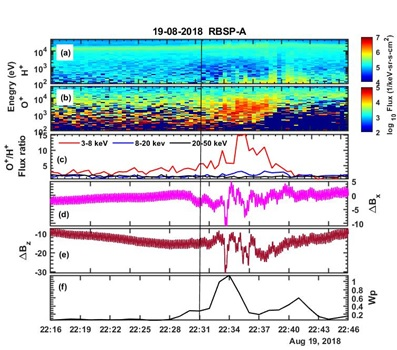
So, what's the big deal with substorms? Well, they increase heavy ion flux in the inner magnetosphere. In simple terms, this means that during a substorm, there's a surge of charged particles like ions in space near Earth. These ions play a crucial role in space weather, affecting things like GPS satellites and geostationary orbit satellites.
The IIG scientists used data from instruments on board the Radiation Belt Storm Probes (RBSP) spacecraft to study 22 substorm events from 2018. They focused on understanding magnetic field depolarization, which is a change in the local magnetic field during substorms, and how it relates to the influx of energetic O+ and H+ ions.
Their findings were published in the journal Advances in Space Research. The study unraveled the role of the plasma sheet in transporting and accelerating ions during substorms. Why is this important? Well, the plasma in space near Earth, known as Geospace, is usually made up of H+ ions. But sometimes, the proportion of O+ ions suddenly increases, and that changes the dynamics of Geospace.
Why does this matter to us? Understanding these ion composition changes helps scientists pinpoint their cause and origin. This knowledge is vital for improving space weather forecasting. With accurate forecasts, we can better protect our satellites, power grids, and even astronauts in space.
In essence, studying substorms and the variations in ion flux they bring is like deciphering a puzzle. It helps scientists unravel the mysteries of space weather, particularly in the region close to Earth. With this knowledge, we can prepare for and mitigate the effects of space weather events, ensuring the reliability of our technology and the safety of our explorations beyond our planet.