







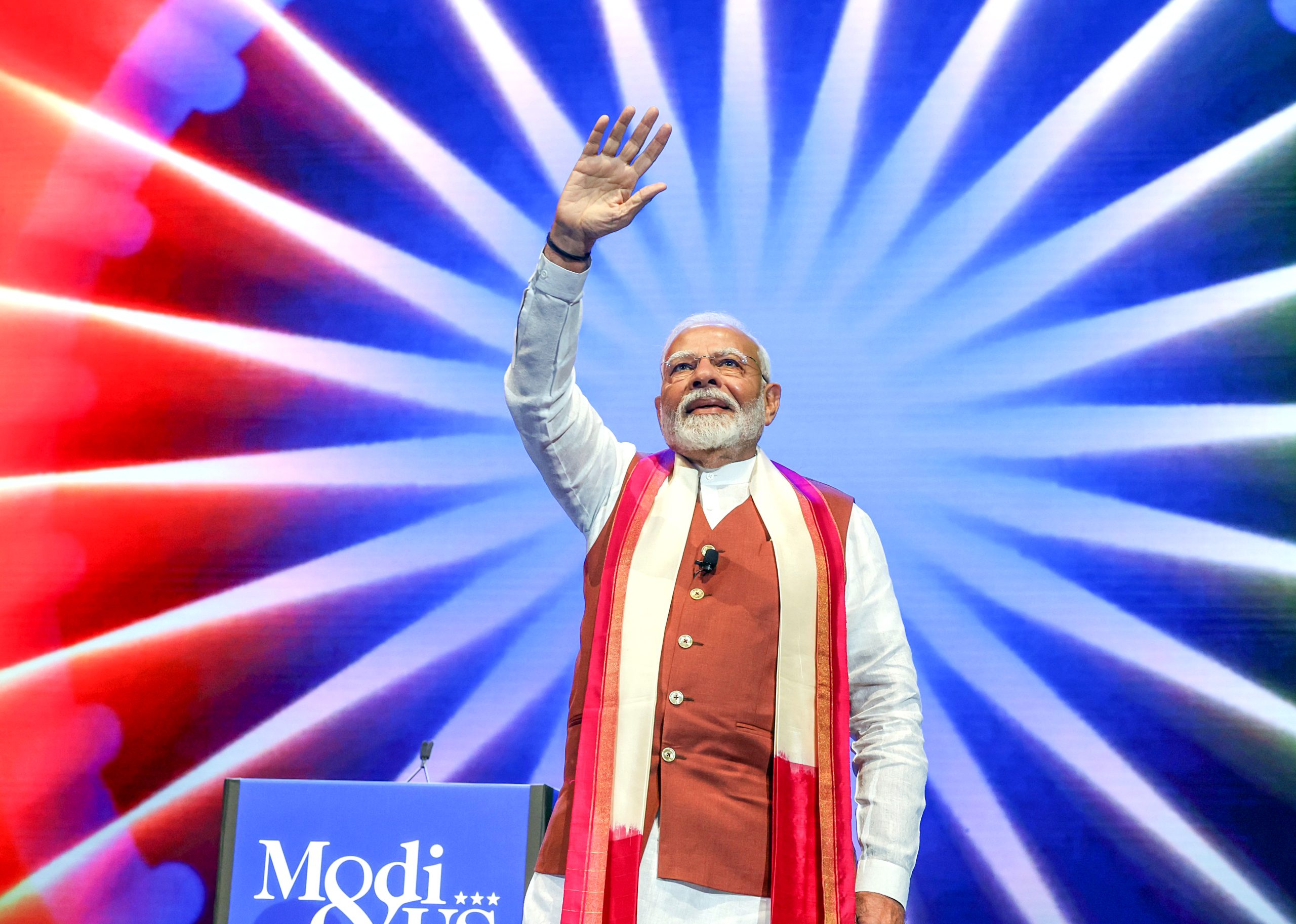
Prime Minister Narendra Modi addressed a large gathering of Indian Americans on the second day of his three-day visit to the United States, emphasizing India’s ambition to become a global hub for semiconductor manufacturing. He said that ‘Made in India’ semiconductor chips will soon power devices around the world.
“India is a launching pad for all sorts of technologies. We are not going to stop or slow down. Our goal is to have more devices worldwide running on Made in India chips,” he said, underscoring the country’s growing manufacturing capabilities in electronics and semiconductors.
The Prime Minister expressed confidence that it wouldn’t be long before ‘Made in India’ chips make their way to the American market. “The day is not far when you will see Made in India chips here in America as well,” he added.
In June 2023, the Indian government approved plans for a semiconductor unit in Sanand, Gujarat. PM Modi said that the foundation stone for Micron’s first semiconductor facility had also been laid recently, with five such units now approved in India.
“This small chip will elevate India’s development to new heights, and this is my guarantee,” he said, highlighting a cumulative investment of nearly ₹1.5 lakh crore across these projects.
The Prime Minister also discussed India’s rapid advancements in digital public infrastructure, saying, “Now India does not lag behind; it creates new systems and leads. India has introduced the concept of digital public infrastructure (DPI) to the world.”
PM Modi pointed out that India’s 5G market has now surpassed that of the U.S. in just two years, and the country is already working on ‘Made in India’ 6G technologies. “This was possible because we implemented policies that promote this sector,” he said.
He also added India’s transformation from being a mobile importer to a key player in mobile manufacturing and reiterated the country’s commitment to climate mitigation.
“Our conviction for reforms is unprecedented. Our Green Energy Transition programme exemplifies this. Despite having 17% of the world’s population, India’s contribution to global carbon emissions is only 4%. We have chosen the path of green energy transition,” he said.
During COP26 in 2021, India pledged an ambitious five-part “Panchamrit” strategy, including achieving 500 GW of non-fossil electricity capacity and reducing emissions by 1 billion tonnes by 2030. The country aims to reduce the emissions intensity of its GDP by 45% and achieve net-zero emissions by 2070.
Later on Sunday, Prime Minister Modi will interact with the CEOs of leading US-based companies to foster greater collaborations between the two countries in the cutting-edge areas of AI, quantum computing, semiconductors, and biotechnology, among others.
(Inputs from ANI)