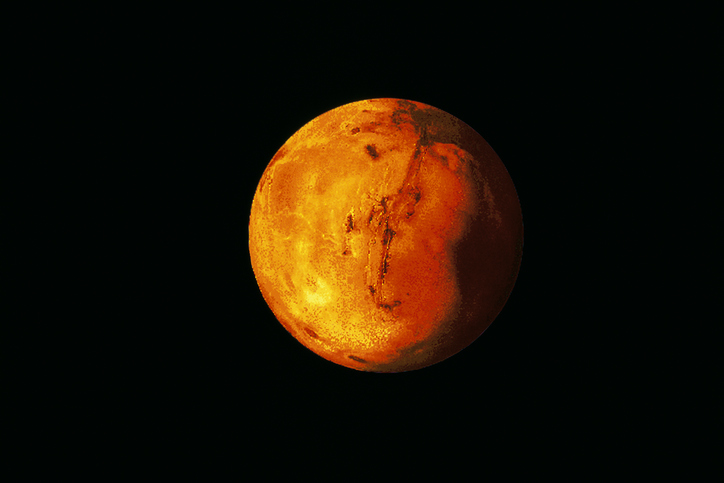
A study released Monday using data from NASA’s Mars InSight lander shows evidence of liquid water far below the surface of the fourth planet, advancing the search for life there and showing what might have happened to Mars’ ancient oceans.
The lander, which has been on the Red Planet since 2018, measured seismic data over four years, examining how quakes shook the ground and determining what materials or substances were beneath the surface.
Based on that data, the researchers found liquid water was most likely present deep beneath the lander. Water is considered essential for life, and geological studies show the planet’s surface had lakes, rivers and oceans more than 3 billion years ago.
“On Earth what we know is where it is wet enough and there are enough sources of energy, there is microbial life very deep in Earth’s subsurface,” said one of the authors, Vashan Wright of the University of California San Diego’s Scripps Institution of Oceanography. “The ingredients for life as we know it exist in the Martian subsurface if these interpretations are correct.”
The study found that large reservoirs of liquid water in fractures 11.5 kilometres (7.15 miles) to 20km beneath the surface best explained the InSight measurements.
It notes that the volume of liquid water predicted beneath the surface is “more than the water volumes proposed to have filled hypothesized ancient Martian oceans”.
“On Earth, groundwater infiltrated from the surface” to deep underground, Wright said. “We expect this process to have occurred on Mars as well when the upper crust was warmer than it is today.”
There is no way to directly study water that deep beneath the surface of Mars, but the authors said the results “have implications for understanding Mars’ water cycle, determining the fates of past surface water, searching for past or extant life, and assessing in situ resource utilization for future missions”.
The study, whose other authors are Matthias Morzfeld of the Scripps Institution of Oceanography and Michael Manga of the University of California Berkeley, was published the week of Aug. 12 in the journal Proceedings of the National Academy of Sciences.
“I’m inspired and I hope the public is also inspired,” Wright said. “Humans can work together to put instruments on a planet… and try to understand what’s going on there.”
(Reuters)