








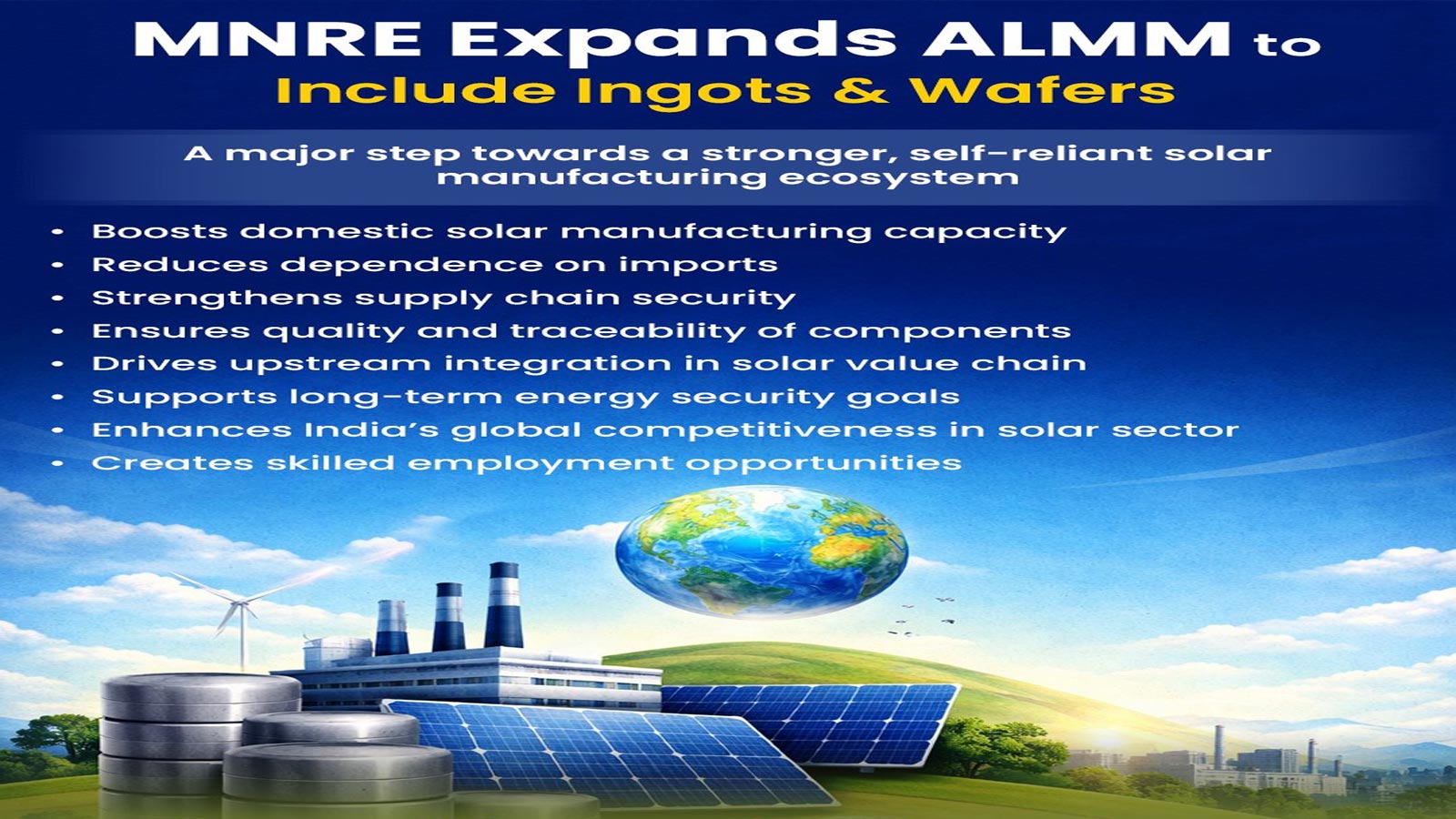
The Ministry of New and Renewable Energy (MNRE) has expanded the scope of the Approved List of Models and Manufacturers (ALMM) framework to include solar ingots and wafers, in a move aimed at strengthening domestic manufacturing and reducing import dependence.
The new provision, which introduces ALMM List-III for ingots and wafers, will come into effect from June 1, 2028, Union Minister Pralhad Joshi said.
Boost to domestic solar ecosystem
Describing the decision as a “decisive step,” Joshi said the expansion would deepen domestic value addition across the solar supply chain, enhance resilience, and improve quality standards.
The move extends mandatory sourcing requirements – already applicable to solar modules and cells – further upstream to ingots and wafers, a segment currently heavily reliant on imports.
Key provisions of the new framework
Under the revised ALMM order:
* All solar projects – including net metering and open access – must use ALMM-listed wafers from June 1, 2028
* A cut-off date will apply to bids submitted under Section 63 of the Electricity Act, 2003, mandating the use of compliant wafers
* The initial ALMM List-III will be issued only when at least three independent manufacturers with a combined capacity of 15 GW are operational
* Manufacturers seeking enlistment must have equivalent ingot manufacturing capacity, promoting backward integration
* From the effective date, ALMM List-I (modules) will include only those modules made using ALMM-listed cells and wafers
The ministry has also included grandfathering provisions to protect projects already in the pipeline from disruption.
Strengthening supply chains and reducing imports
Wafers form a critical intermediate stage in solar manufacturing, linking polysilicon to solar cells. India currently has limited domestic wafer capacity, making the sector vulnerable to global supply disruptions.
The MNRE said the new framework is expected to attract investments in ingot and wafer manufacturing, improve supply chain security, ensure quality and traceability across the solar value chain and generate skilled employment in upstream manufacturing.
Supporting India’s clean energy goals
The expansion of ALMM is aligned with India’s push for self-reliance under ‘Atmanirbhar Bharat’ and its target of achieving 500 GW of non-fossil fuel capacity by 2030.
Introduced in 2019, the ALMM framework has already driven significant growth in domestic manufacturing. Capacity under ALMM List-I (modules) has expanded sharply, while ALMM List-II (cells) has seen rapid uptake since its introduction.