








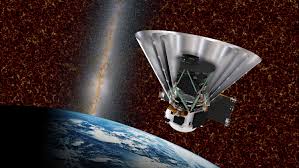
NASA is preparing to launch a megaphone-shaped observatory on a mission to better understand what happened immediately after the Big Bang that initiated the universe and to search the Milky Way for reservoirs of water, a crucial ingredient for life.
The U.S. space agency’s SPHEREx space telescope is tentatively scheduled to be launched on Friday aboard a SpaceX Falcon 9 rocket from Vandenberg Space Force Base in California.
SPHEREx – short for Spectro-Photometer for the History of the Universe, Epoch of Reionization and Ices Explorer – is looking to answer questions about the origin of the universe while mapping the distribution of galaxies.
Closer to home – relatively speaking – SPHEREx will look within our galaxy for reservoirs of water frozen on the surface of interstellar dust grains in large clouds of gas and dust that give rise to stars and planets.
The observatory during its planned two-year mission will collect data on more than 450 million galaxies, as well as more than 100 million stars in the Milky Way, as it explores the origins of the universe and the galaxies within it. It will create a three-dimensional map of the cosmos in 102 colors -individual wavelengths of light.
The mission is intended to gain insight into a phenomenon called cosmic inflation, the rapid and exponential expansion of the universe from a single point in a fraction of a second after the Big Bang that occurred roughly 13.8 billion years ago. By way of comparison, Earth is about 4.5 billion years old.
“We have pretty good evidence that inflation occurred, but the physics driving that event is really uncertain,” said cosmologist Olivier Dore of Caltech and NASA’s Jet Propulsion Laboratory, a SPHEREx project scientist.
“By mapping the distribution of galaxies over the whole sky, we can directly constrain unique properties of inflation. This is why we want to map the whole sky and why we need spectroscopy (studying objects based on color) to make the map 3D. The fact that we can connect these two things – the distribution of galaxies on large scales all the way to the physics of inflation – is very powerful and very mind-boggling and almost magical,” Dore added.
Jim Fanson, SPHEREx project manager at the Jet Propulsion Laboratory, called cosmic inflation “the consensus framework for explaining aspects of the universe that we observe on large scales.”
“It postulates that the universe expanded by a trillion-trillion-fold in a small fraction of a second after the Big Bang,” Fanson said.
SPHEREx is set to take pictures in every direction around Earth, splitting the light from billions of cosmic sources such as stars and galaxies into their component wavelengths to determine their composition and distance. Researchers also will measure the collective glow of light from the space between galaxies.
In addition, SPHEREx will look for water and molecules including carbon dioxide and carbon monoxide frozen on the surface of dust grains in molecular clouds, which are dense regions of gas and dust in interstellar space. Scientists believe that reservoirs of ice bound to dust grains in these clouds are where most of the universe’s water forms and dwells.
Being launched along with SPHEREx is a constellation of satellites for NASA’s PUNCH mission to observe the sun’s corona, the outermost layer of its atmosphere. The aim is to better understand the solar wind, the continuous flow of charged particles from the sun.
“I think the beauty of astronomy is that every time we look at the sky in a new way or from a different angle, we discover new phenomena,” Dore said. “And the fact is SPHEREx will look at the sky in totally new ways.”
“It will be an unprecedented dataset to mine,” Dore added, “and there is no doubt in my mind we will discover new cosmic phenomena.”
(Reuters)