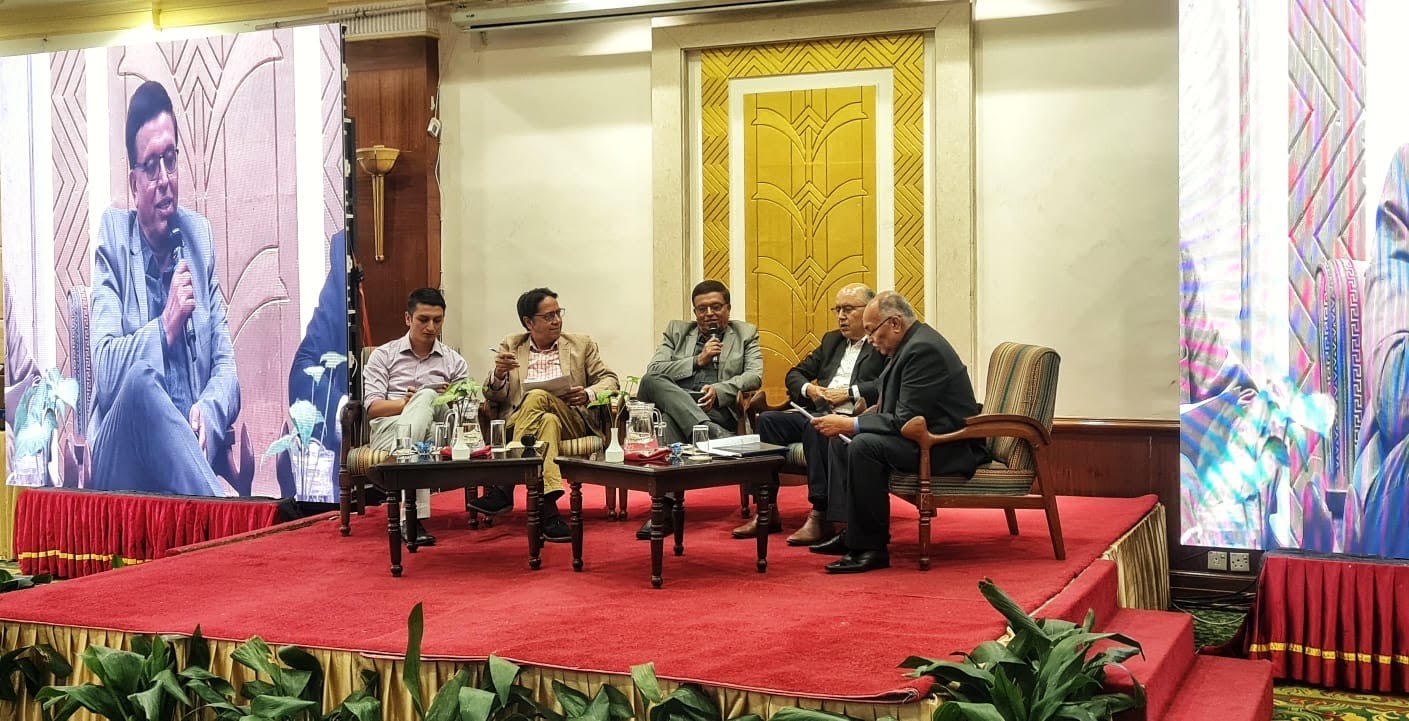
National Seminar organised by Centre for Social Innovation and Foreign Policy (CESIF) on “Reflecting on BRI: Experiences and Lessons from South Asia” held in Kathmandu, navigated the opportunities and challenges of China’s Belt and Road Initiative with experiences from regional neighbours who have implemented the projects under BRI. The seminar was held at a critical time of accelerated Chinese push for the BRI implementation plan agreement with Nepal.
Executive Chairperson of CESIF Ambassador Vijay Kant Karna raised concerns about the rationale and significance of the BRI Implementation Plan Agreement instead of negotiating projects on an individual basis. Delivering the keynote speech, former Minister for Finance, Mr. Prakash Sharan Mahat stressed that Nepal should have the same approach to financial support from all sources because where the support comes from does not matter so much, as long as it serves the country’s national interest.
Another keynote speaker, Raj Kishor Yadav, Chairman of the International Relations and Tourism Committee of the parliament, stressed a need for wider discussion on BRI in the parliament, urging the government to release the BRI MoU signed with China in 2017. He further mentioned that the government should clarify the current status of negotiation on BRI and should not opt for any commercial loans. Nepal stresses on grants and concessional loans from China with interest rates at par with other multilateral financial institutions and without any strings attached.
Speakers from Sri Lanka, Bangladesh, and India presented the experiences and perceptions of individual countries on BRI. Elaborating on Nepal’s experience with BRI, senior journalist Anil Giri stressed the lack of understanding about BRI among policymakers, politicians, and the public alike. He pointed to forging a national consensus on the negotiation bottom line to move forward with BRI, particularly due to some ambiguous conditions in the MoU such as policy exchange and financial integration.
Talal Rafi, Economist and Fellow at Oxford Global Society, Sri Lanka, pointed out that International Sovereign Bank debt ranks above the Chinese bilateral debt, Sri Lanka’s experience with BRI shows a lack of transparency, ad-hoc planning, selection of projects without viability assessment, lack of technological spillover, and environmental concerns.
Mostakim Bin Motaher, Associate Professor at Jahangirnagar University of Bangladesh, highlighted that China’s presence in Bangladesh’s infrastructure has surged quite significantly in recent years, with deep trade and investment ties. Some of the common features of the projects financed by China are escalation of cost, non-transparent or absent bidding procedures, and delays in execution.
Dr. Constantino Xavier’s presentation cited three reasons behind India’s decision to stay out of the BRI: the China-driven and led unilateral nature of the initiative, Chinese economic and strategic interests behind the Initiative unfavorable for India, and the concern about its capacity to absorb capital. He also highlighted how this decision has affected India’s relations with its neighbors, whereby India reinvented its delivery system.
The first panel discussion underscored the necessity for transparent discourse and strategic negotiation to navigate Nepal’s engagement with the BRI effectively.
The second panel discussion hosted delegates from countries across South Asia to discuss experiences and lessons for Nepal from their BRI journey.More than a hundred participants including policymakers, politicians, national and international experts, analysts, academics, diplomats, bureaucrats, and journalists attended the event.
By Sweta Singh (Kathmandu)