







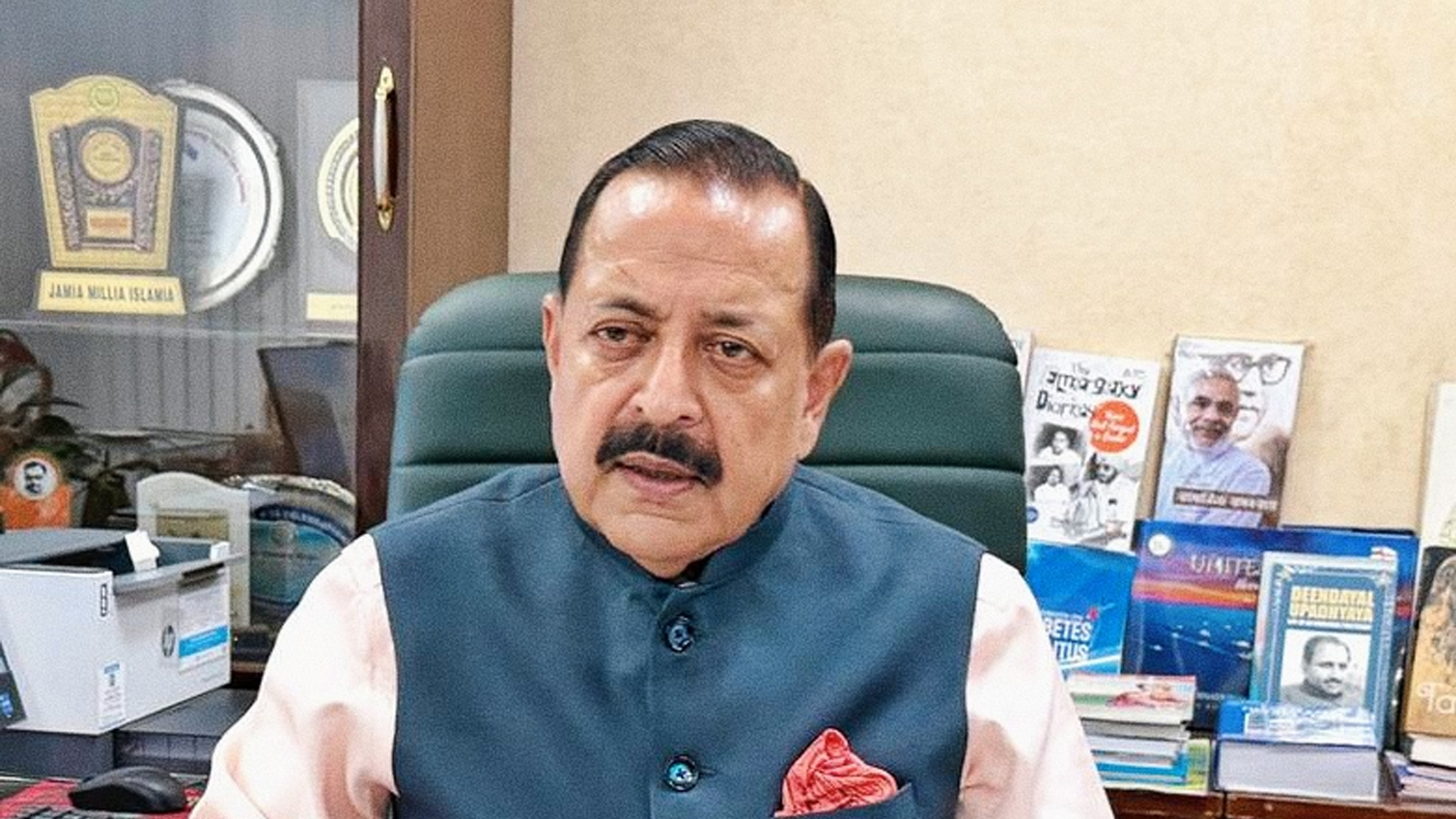
Union Minister of State (Independent Charge) for Science and Technology, Dr. Jitendra Singh, on Saturday said the National Education Policy (NEP) 2020 has democratized aptitude-based learning, enabling students from Tier-2 and Tier-3 towns such as Doda to compete on an equal footing with their counterparts in metropolitan cities.
Addressing a two-day hybrid conference organised by Government Degree College, Doda, on the theme “Implementation of the National Education Policy 2020 in Jammu & Kashmir: Challenges of Inclusion, Equity and Accessibility”, the minister said the policy has fundamentally transformed India’s education system by shifting its focus from degrees to skills, innovation and entrepreneurship.
Singh said NEP 2020 has replaced rigid academic pathways with greater flexibility, allowing students to choose subjects based on their aptitude and interests rather than social expectations or compulsion. “A degree is no longer a trophy, and employment no longer means only a government job,” he said, adding that the policy is preparing young Indians for the emerging knowledge economy.
Congratulating Government Degree College, Doda, and its Principal, Dr. Javed Iqbal, for organising the conference, Singh described the institution as one of the oldest and most distinguished centres of higher education in the region. He recalled that students from remote areas once travelled long distances to Doda and Bhaderwah to pursue higher education due to the scarcity of educational institutions and said the district has the potential to emerge as a major educational hub.
The minister said multidisciplinary learning under the NEP has made classrooms more vibrant by encouraging students to pursue subjects aligned with their interests. Citing an example from an institution implementing the policy, he said a literature professor had expressed delight at seeing science students voluntarily attending literature classes out of genuine interest, calling it a reflection of the transformative impact of the new education framework.
Highlighting India’s startup ecosystem, Singh said the country has witnessed remarkable growth, with the number of startups increasing from nearly 350 in 2014 to more than 2.3 lakh today, making India the world’s third-largest startup ecosystem. More than half of these startups, he noted, have emerged from Tier-2 and Tier-3 cities, demonstrating that innovation is no longer confined to metropolitan centres.
Singh also pointed to the success of the Lavender Revolution under the CSIR Aroma Mission, describing it as an example of science-led rural entrepreneurship. Beginning with a small patch of land in Bhaderwah, lavender cultivation has expanded across Doda district, the Kashmir Valley and other Himalayan states, generating new livelihood opportunities and strengthening the rural economy.
Calling for Doda to develop a distinct identity in innovation and entrepreneurship, Singh suggested that Government Degree College establish incubation support for Himalayan products, aroma-based enterprises and allied sectors in collaboration with the Ministry of AYUSH, the Jammu and Kashmir AYUSH Department and CSIR’s Aroma Mission. Such initiatives, he said, could promote wellness products, tourism and value-added rural enterprises while creating employment opportunities.
The minister also highlighted the development of scientific infrastructure in the region, including a Himalayan laboratory, and urged educational institutions to connect students with research, innovation and entrepreneurship.
Singh encouraged colleges to familiarise students with flagship government initiatives such as the Pradhan Mantri Mudra Yojana and PM Vishwakarma Yojana, saying greater awareness would help young people convert their knowledge and traditional skills into sustainable livelihoods.
Referring to the role of technology in education, Singh said improved digital connectivity has removed geographical barriers, enabling students from remote regions to access quality learning resources, prepare for competitive examinations and build successful careers without leaving their hometowns.
Describing the present period as one of the most promising for India’s youth, Singh said the generation currently pursuing education will lead the country during the centenary year of Independence in 2047. He urged teachers and educational institutions to mentor students with a long-term vision so they become innovators, entrepreneurs, responsible citizens and nation-builders capable of contributing to the vision of a developed India.