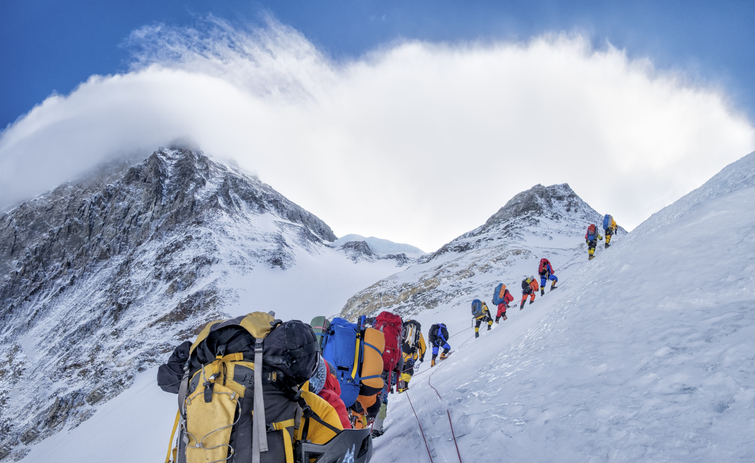
Nepal will increase the permit fees for climbing Mount Everest by more than 35%, making the world’s tallest peak more expensive for mountaineers for the first time in nearly a decade, officials said on Wednesday.
Income from permit fees and other spending by foreign climbers is a key source of revenue and employment for the cash strapped nation, home to eight of the world’s 14 highest mountains, including Mount Everest.
A permit to climb the 8,849 metre (29,032 feet) Mount Everest will cost $15,000, said Narayan Prasad Regmi, director general of the Department of Tourism, announcing a 36% rise in the $11,000 fee that has been in place for nearly a decade.
“The royalty (permit fees) had not been reviewed for a long time. We have updated them now,” Regmi told Reuters.
The new rate will come into effect from September and apply for the popular climbing April-May season along the standard South East Ridge, or South Col route, pioneered by New Zealander Sir Edmund Hillary and Sherpa Tenzing Norgay in 1953.
Fees for the less popular September-November season and the rarely climbed December-February season will also increase by 36%, to $7,500 and $3,750 respectively.
Some expedition organisers said the increase, under discussion since last year, was unlikely to discourage climbers. About 300 permits are issued each year for Everest.
“We expected this hike in permit fees,” said Lukas Furtenbach of Austria-based expedition organiser, Furtenbach Adventures.
He said it was an “understandable step” from the government of Nepal. “I am sure the additional funds will be somehow used to protect the environment and improve safety on Everest,” Furtenbach said.
Regmi did not say what the extra revenue would be used for.
Hundreds of climbers try to scale Mount Everest and several other Himalayan peaks every year.
Nepal is often criticised by mountaineering experts for allowing too many climbers on Everest and doing little to keep it clean or to ensure climbers’ safety.
Regmi said cleaning campaigns were organised to collect garbage and rope fixing as well as other safety measures were undertaken regularly.
Climbers returning from the Everest say the mountain is becoming increasingly dry and rocky with less snow or other precipitation, which experts say could be due to global warming or other environmental changes.
(Reuters)