






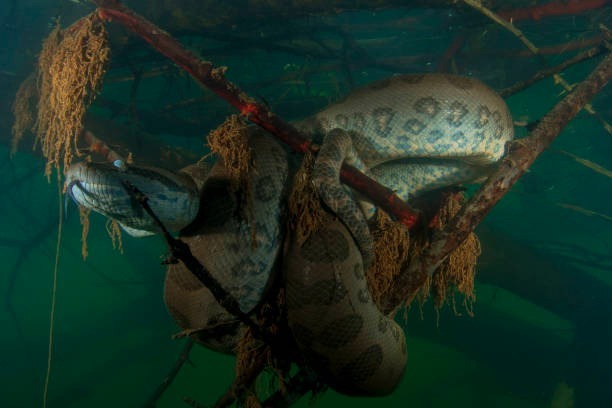
Researchers in the Amazon have discovered the world’s largest snake species – an enormous green anaconda – in Ecuador’s rainforest that split off from its closest relatives 10 million years ago, though they still nearly look identical to this day.
A video shared online shows the scale of these 20-foot-long (6.1-meter-long) reptiles as one of the researchers, Dutch biologist Freek Vonk, swims alongside a giant 200-kilo (441-pound) specimen.
https://x.com/DDIndialive/status/1763410834716283357?s=20
It was thought that there was only one species of green anaconda in the wild, the Eunectes murinus, but the scientific journal Diversity revealed that the new “northern green anaconda” belongs to a different, new species, Eunectes akiyama.
“What we were there to do was use the anacondas as an indicator species for what kind of damage is being done by the oil spills that are plaguing the Yasuni in Ecuador, because the oil extraction is absolutely out of control,” researcher Bryan G. Fry said.
Fry is an Australian professor of biology at the University of Queensland who for almost 20 years has been investigating anaconda species found in South America. According to him, the discovery allows them to show that the two species split from each other almost 10 million years ago.
“But the really amazing part was, despite this genetic difference, and despite their long period of divergence, the two animals are completely identical,” he said.
Although green anaconda snakes are very similar visually, there is a genetic difference of 5.5%, which surprised the scientists.
“Which is an incredible amount of genetic difference, particularly when you put it in the context that we’re only 2% different from chimpanzees,” Fry said.
Anacondas are incredibly useful sources of information for the ecological health of the area and the potential impacts on human health of oil spills in the region, Fry said.
Some of the snakes they studied in parts of Ecuador were heavily polluted by oil spills, and the anacondas and arapaima fish are accumulating a large amount of the petrochemical metals, he added.
“That means that if arapaima fish are accumulating these oil spill metals, that they need to be avoided by pregnant women, just like women avoid salmon and tuna and other parts of the world for fear of methylmercury,” he said.
(Inputs from Reuters)