






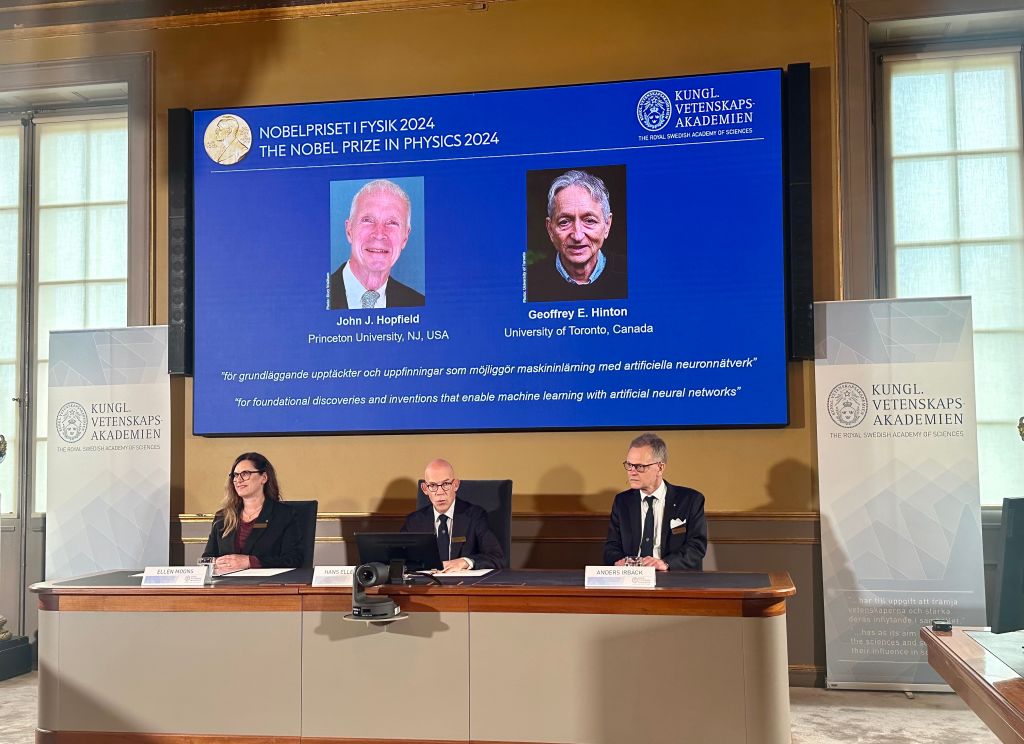
U.S. scientist John Hopfield and British-Canadian Geoffrey Hinton won the 2024 Nobel Prize in Physics for discoveries and inventions that laid the foundation for machine learning, the award-giving body said on Tuesday.
“This year’s two Nobel Laureates in physics have used tools from physics to develop methods that are the foundation of today’s powerful machine learning,” the award-giving body said in a statement.
“Machine learning based on artificial neural networks is currently revolutionising science, engineering and daily life.”
Hopfield, a professor at Princeton University, created an associative memory that can store and reconstruct images and other types of patterns in data, the academy said.
Hinton, who works as a professor at University of Toronto, invented a method that can autonomously find properties in data and carry out tasks such as identifying specific elements in pictures, it added.
“I am flabbergasted. I had no idea this would happen,” Hinton said over the phone to the press conference announcing the prize.
A pioneer of artificial intelligence, Hinton quit Google in 2023 and said he did so to speak freely about the technology’s dangers, after realising computers could become smarter than people far sooner than he and other experts had expected.
“While machine learning has enormous benefits, its rapid development has also raised concerns about our future,” Ellen Moons, chair of the Nobel Committee for Physics, said.
“Collectively, humans carry the responsibility for using this new technology in a safe and ethical way, for the greatest benefit of humankind.”
SECOND 2024 NOBEL PRIZE AWARDED
The award comes with a prize sum of 11 million Swedish crowns ($1.1 million), which is shared between the winners if there are several. The physics prize is awarded by the Royal Swedish Academy of Sciences.
Widely considered the most prestigious prize for physicists across the world, it was created, along with awards for achievements in science, literature and peace, in the will of Alfred Nobel.
The prizes have been awarded with a few interruptions since 1901, though the Nobel economics honour is a later addition in memory of the Swedish businessman and philanthropist, who had made a fortune from his invention of dynamite.
Outside the sometimes controversial choices for peace and literature, physics often makes the biggest splash among the prizes, with the list of past winners featuring scientific superstars such as Albert Einstein, Niels Bohr and Enrico Fermi.
Last year’s physics prize was awarded to Pierre Agostini, Ferenc Krausz and Anne L’Huillier for their work in creating ultra-short pulses of light that can give a snapshot of changes within atoms, potentially improving the detection of diseases.
Physics is the second Nobel to be awarded this week, after U.S. scientists Victor Ambros and Gary Ruvkun won the medicine prize for their discovery of microRNA and its role in gene regulation, shedding light on how cells specialise.
(Reuters)