











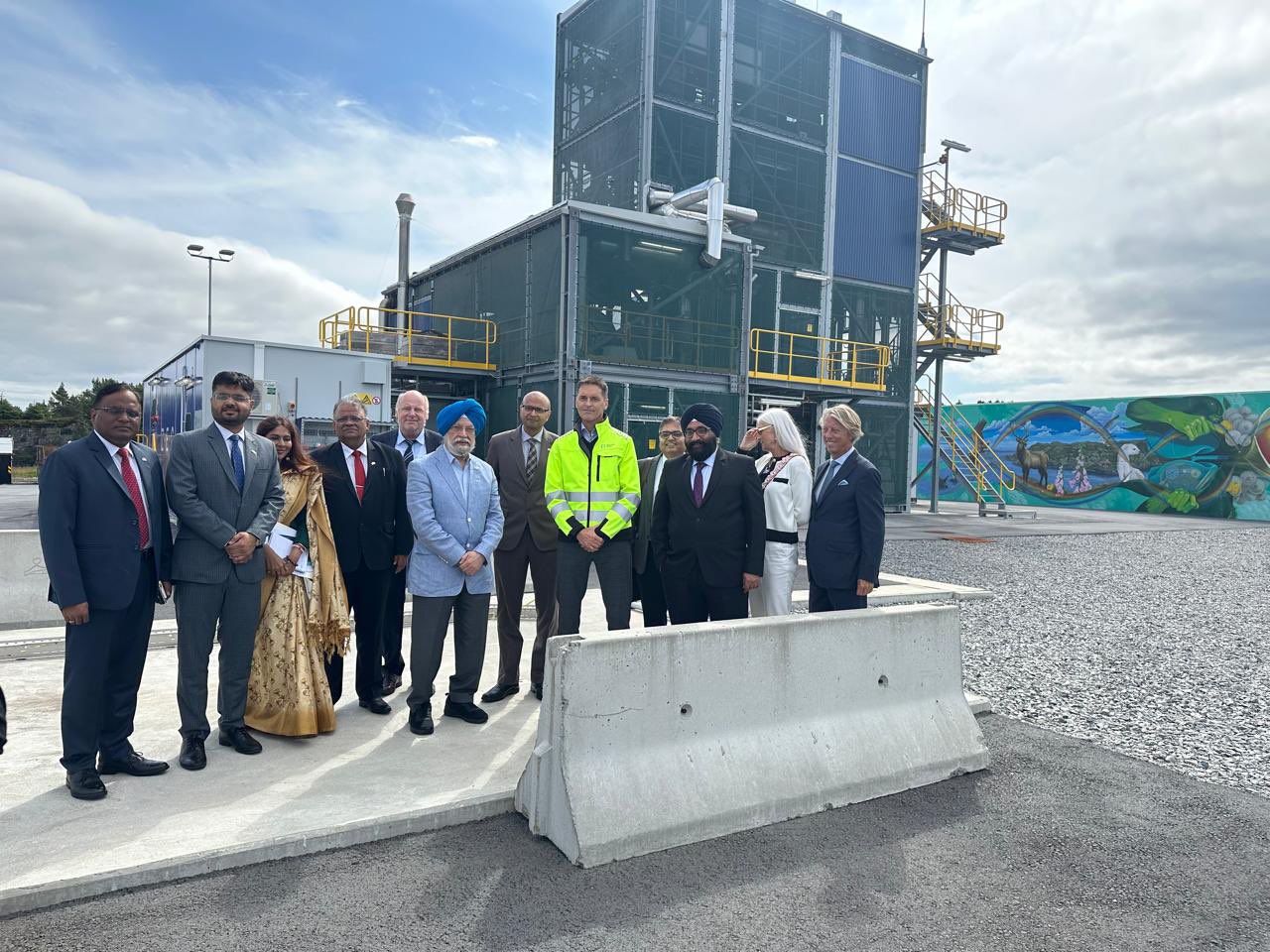
Union Minister of Petroleum and Natural Gas, Hardeep Singh Puri, said on Monday that the government is exploring various projects in Norway to leverage its expertise to upgrade and expand India’s energy capabilities.
“In our continued quest to provide momentum to India’s efforts to achieve energy security under the leadership of Prime Minister Narendra Modi, I visited the Northern Lights CO₂ Terminal in Bergen, Norway. It is the largest project for carbon storage funded by the Norwegian government and partnered by Equinor, Shell & Total Energies,” Puri said in a post on X.
“We are reviewing this and similar projects to upgrade and expand India’s energy capabilities. Norway’s expertise in deepwater exploration, seismic oil surveys, offshore wind, and carbon capture and storage (CCS) technologies aligns well with India’s ambitious energy transition agenda,” Puri added.
He pointed out that Norway’s unique terminal in Bergen can store up to 100 million tonnes of carbon dioxide. It has an open and flexible infrastructure to transport CO₂ from capture sites by ship to a receiving terminal in western Norway for intermediate storage, before being transported by pipeline for safe and permanent storage in a reservoir 110 km offshore and 2,600 metres under the seabed.
Carbon capture and storage (CCS) technology involves capturing carbon dioxide (CO₂) emissions from industrial sources like power plants and factories, transporting it, and then storing it underground to prevent its release into the atmosphere. This process is a key strategy for reducing greenhouse gas emissions and mitigating climate change.
The process involves separating CO₂ from other gases at the source of emission, such as power plants or industrial facilities. Different capture methods exist, including post-combustion capture (separating CO₂ from flue gas), pre-combustion capture (separating CO₂ before fuel combustion), and oxy-fuel combustion (burning fuel with pure oxygen).
The captured CO₂ is typically compressed into a supercritical state (liquid-like) to be transported via pipelines, ships, or other means. The CO₂ is then injected deep underground into geological formations like depleted oil and gas reservoirs, saline aquifers, or other suitable rock formations.
These formations are chosen to ensure the CO₂ remains trapped and isolated from the atmosphere for long periods.
CCS is a crucial technology for mitigating climate change by preventing CO₂ from entering the atmosphere. It can help decarbonise industries that produce significant CO₂ emissions, such as cement and steel production.
IANS


