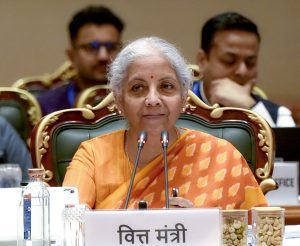







In a major move to ease the tax burden on middle-class taxpayers, Finance Minister Nirmala Sitharaman on Saturday announced fresh tax slabs under the new tax regime in the Union Budget 2025-26.
The new tax slabs aim to provide relief to individuals earning up to Rs 12 lakh annually, with the exemption limit set at Rs 12.75 lakh for salaried individuals (including standard deductions).
Finance Minister Sitharaman said that after the changes made under the new tax regime, there will be a saving of Rs 80,000 on an income of Rs 12 lakh, Rs 70,000 on an income of Rs 18 lakh, and Rs 1,10,000 on an income of Rs 25 lakh.
Under the new tax slabs announced in the budget, there is no tax on annual incomes up to Rs 4 lakh.
For income between Rs 4 lakh and Rs 8 lakh, the tax rate will be 5 per cent, while incomes between Rs 8 lakh and Rs 12 lakh will be taxed at 10 per cent.
For higher income brackets, the tax rates will increase progressively, with 15 per cent for Rs 12 lakh to Rs 16 lakh, 20 per cent for Rs 16 lakh to Rs 20 lakh, 25 per cent for Rs 20 lakh to Rs 24 lakh, and 30 per cent for incomes above Rs 24 lakh.
In addition to the revised tax slabs, Finance Minister Sitharaman also announced an increase in the tax rebate available under Section 87A.
This means that individuals with a net taxable income of up to Rs 12 lakh will not be required to pay any income tax.
However, if your annual income is exactly Rs 12 lakh, you will still pay tax according to the applicable slab rates but will benefit from the rebate, reducing your final tax liability.
In simpler terms, if you’re a salaried individual or earn other types of “regular income” up to Rs 12 lakh, you will not have to pay any tax due to both the enhanced rebate and the revised tax slabs.
However, income from capital gains will not be eligible for the rebate and will be taxed separately under different rules.
The new tax regime will come into effect from the new financial year 2025-26, starting on April 1, 2025, provided the proposals are approved by Parliament.
In the current structure, individuals earning up to Rs 3 lakh pay no tax, and tax rates increase incrementally as income rises.
However, under the old tax regime, the basic exemption limit was Rs 2.5 lakh, and individuals had access to a range of deductions.
For income between Rs 2.5 lakh and Rs 5 lakh, a 5 per cent tax rate was applied, while incomes between Rs 5 lakh and Rs 10 lakh were taxed at 20 per cent.
For earnings above Rs 10 lakh, a 30 per cent tax rate applies.
(Inputs from IANS)