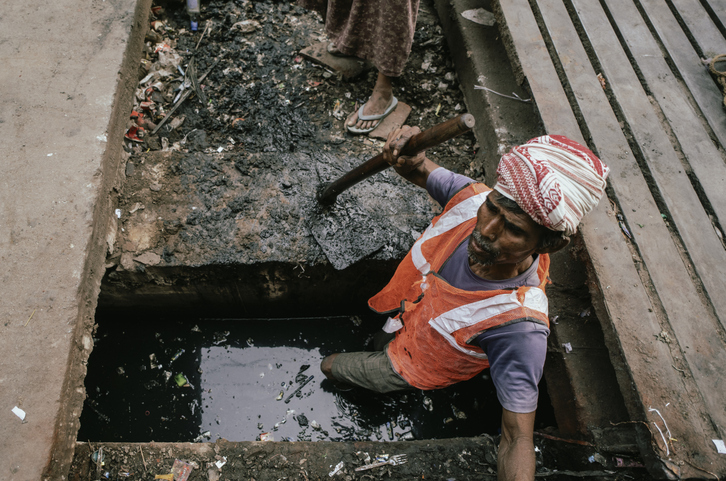
The National Action for Mechanised Sanitation Ecosystem (NAMASTE) scheme has profiled over 57,758 Sewer and Septic Tank Workers (SSWs) across India, with 54,574 workers validated so far, Union Minister of State for Social Justice and Empowerment, Ramdas Athawale, informed the Lok Sabha on Tuesday.
The initiative, launched in the 2023-24 fiscal year, seeks to ensure safety, dignity, and socio-economic empowerment for sanitation workers. It is being implemented across more than 4,800 Urban Local Bodies (ULBs) under a collaboration between the Ministry of Social Justice and Empowerment (MoSJ&E) and the Ministry of Housing and Urban Affairs (MoHUA).
The data reveals that sanitation work remains deeply entrenched in social inequalities, with 67.91% of the workers coming from Scheduled Castes (SC), followed by 15.73% from Other Backward Classes (OBC), 8.31% from Scheduled Tribes (ST), and 8.05% from the General category.
Over 16,791 Personal Protective Equipment (PPE) kits and 43 safety devices kits for Emergency Response Sanitation Units (ERSUs) have been distributed to improve worker safety. Health benefits have been extended to 13,604 workers and their families through Ayushman cards. A capital subsidy of Rs. 13.96 crore has been granted to 503 sanitation workers and dependents for sanitation-related projects. Additionally, Rs. 2.85 crore has been disbursed to 226 workers for alternative self-employment opportunities. 837 workshops have been conducted across municipalities to raise awareness of safe sanitation practices and to train workers on preventing hazardous cleaning methods.
To eradicate unsafe manual cleaning practices, the government has focused on mechanization. Under the Swachh Bharat Mission-Urban 2.0 (SBM-U 2.0), Rs. 371 crore has been allocated to 26 states and Union Territories for procuring 2,585 desludging vehicles. This mechanization is expected to reduce health hazards and improve efficiency in sanitation work.
Furthermore, guidelines have been issued by MoHUA to all states and UTs, emphasizing strict safety procedures, the establishment of ERSUs, and the use of modern equipment for sewer and septic tank cleaning.
The integration of data from states like Tamil Nadu and Odisha into the central NAMASTE database is currently underway to ensure a more comprehensive outreach. The government is actively working to expand the scheme’s benefits to all sanitation workers nationwide.