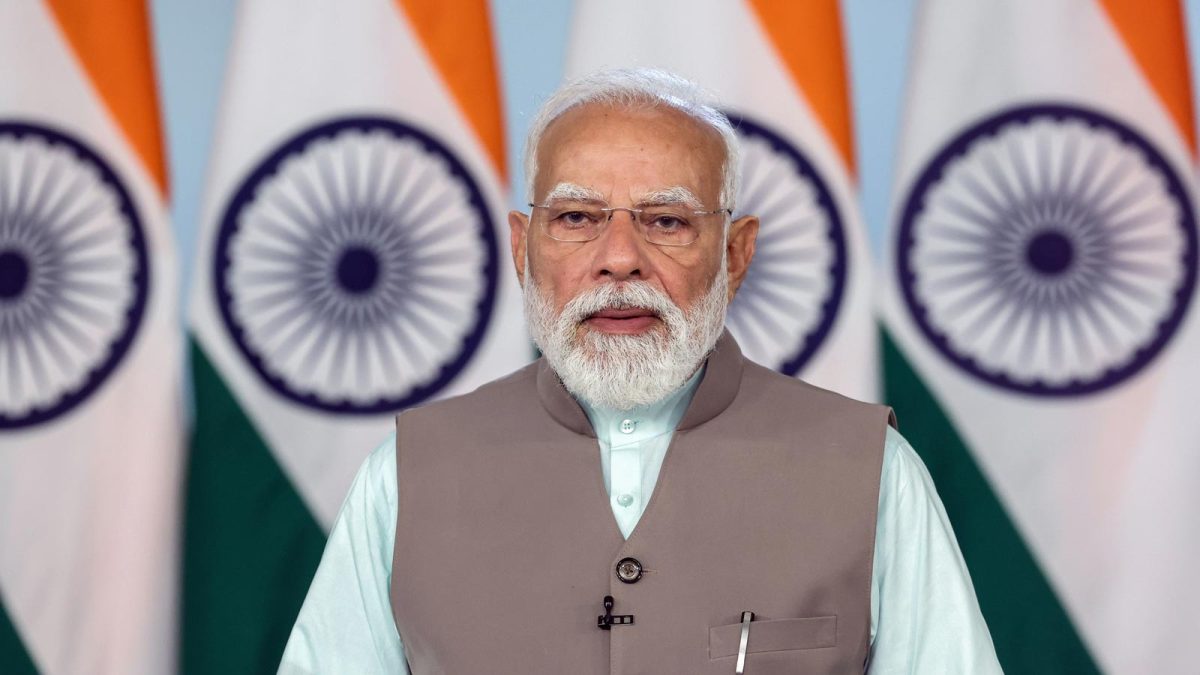
The Prime Minister Narendra Modi on Thursday addressed the Karmayogi Sadhana Saptah through a video message, marking the foundation day of the Capacity Building Commission (CBC), and underlined the need to make governance more citizen-centric, technology-driven and responsive.
Extending his wishes to participants, the Prime Minister said the initiative is aimed at ensuring that public service remains relevant in a rapidly changing global environment. “Karmayogi Sadhana Saptah is an important link in that very effort to ensure our public service stays relevant and responsive in the 21st century,” he said.
Highlighting the guiding philosophy of governance, the Prime Minister said the core principle being followed today is “Nagrik Devo Bhava”, with a focus on making public services more capable and sensitive towards citizens. “Governance is now being given a new identity by making it truly citizen-centric,” he said.
Referring to the creation of the Capacity Building Commission, the Prime Minister said there was a need for a dedicated institution to enhance the capabilities of government employees. He added that the Commission, along with the iGOT Mission Karmayogi platform, is aimed at building a workforce that is modern, capable and sensitive.
Linking the initiative to the broader vision of a “Viksit Bharat”, the Prime Minister said public institutions and civil servants have a key role in supporting economic growth, infrastructure development, technology adoption and skill-building. “Today’s India is aspirational, every citizen has dreams and goals, and upon all of us lies the responsibility to provide maximum support to fulfil them,” he said.
He said governance should be measured by improvements in ease of living and quality of life, and urged public servants to continuously learn and adapt. Stressing the importance of duty, the Prime Minister said decisions taken with a sense of responsibility would have a greater impact. “Before every decision, when we think what our duty demands, the impact of our decisions will multiply many times over by itself,” he said.
The Prime Minister also called on officials to view their work in the context of long-term impact, saying individual transformation can lead to institutional change. He added that such transformation requires a spirit of selfless service.
Emphasising the role of technology, the Prime Minister said its integration into governance has deepened over the past decade and will accelerate further with the rise of artificial intelligence. “A better administrator, a better public servant, will be one who possesses a strong understanding of technology and data, this will form the very basis of decision-making,” he said, adding that capacity building in AI should be a focus area.
On India’s federal structure, the Prime Minister said the country’s progress depends on the collective advancement of states and called for bridging regional gaps. “We have to break silos and move forward with better coordination, shared understanding and a whole-of-government approach, only then will every mission succeed,” he said.
In his concluding remarks, the Prime Minister said public trust in governance depends on the conduct of officials, noting that local offices are often the primary interface between citizens and the state. He urged officials to uphold that trust, calling it the foundation of democracy.