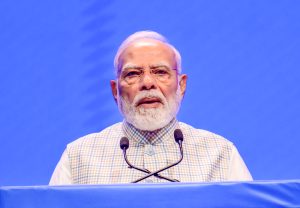
Prime Minister Narendra Modi on Wednesday paid homage to former President Dr A.P.J. Abdul Kalam on his birth anniversary, calling him a ‘Rashtra Ratna’ even before he assumed the office of ‘Rashtrapati’.
Remembering Kalam, the Prime Minister highlighted his journey from humble beginnings in Rameswaram, where he sold newspapers to support his family, to becoming India’s leading aerospace scientist and the 11th President of India. Known as the “Missile Man of India”, Kalam played a pivotal role in India’s missile and nuclear weapons programmes, including the 1998 Pokhran-II nuclear tests.
In a message shared on X, PM Modi said, “His life reminds us that humility and hard work are vital for success. May we continue to build the India he envisioned…an India that is strong, self-reliant and compassionate.” He added that Kalam’s life would continue to inspire citizens across the country.
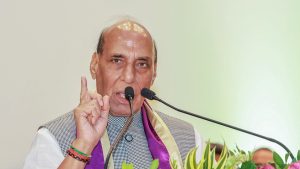
Union Home Minister Amit Shah paid tribute, describing Kalam as a “scientific genius” who elevated India’s capabilities in science, defence, and technology through his unwavering patriotism. Defence Minister Rajnath Singh called him “a visionary scientist, inspirational leader and a true patriot,” noting that his dedication to defence, science, and youth empowerment strengthened India’s self-reliance.
Jammu and Kashmir Lt. Governor Manoj Sinha remembered Kalam as “a man of simplicity, integrity, wisdom, knowledge, and perseverance,” while Assam Chief Minister Himanta Biswa Sarma hailed him as the “Missile Man of India” whose contributions to national security and scientific advancement remain unparalleled.
Born on October 15, 1931, in Rameswaram, Tamil Nadu, Dr Kalam specialized in Aeronautical Engineering from the Madras Institute of Technology. He played a key role in developing India’s first indigenous Satellite Launch Vehicle (SLV-III) and later led the Integrated Guided Missile Development Programme, responsible for the operationalisation of AGNI and PRITHVI missiles. As Scientific Adviser to the Defence Minister and Secretary of Defence Research & Development, he spearheaded India’s strategic missile systems and contributed to India becoming a nuclear weapon state.
Dr Kalam also guided Technology Vision 2020, aiming to transform India into a developed nation, and served as Principal Scientific Advisor to the Government of India. He devoted his later years to academia and youth empowerment, teaching at Anna University and inspiring students across the country.
A prolific author, his books such as Wings of Fire, India 2020, My Journey, and Ignited Minds have inspired millions in India and abroad. Honoured with the Padma Bhushan (1981), Padma Vibhushan (1990), and Bharat Ratna (1997), Dr Kalam remains one of India’s most celebrated scientists and leaders.
He assumed the presidency on July 25, 2002, focusing on transforming India into a self-reliant and developed nation, leaving a lasting legacy that continues to inspire generations.