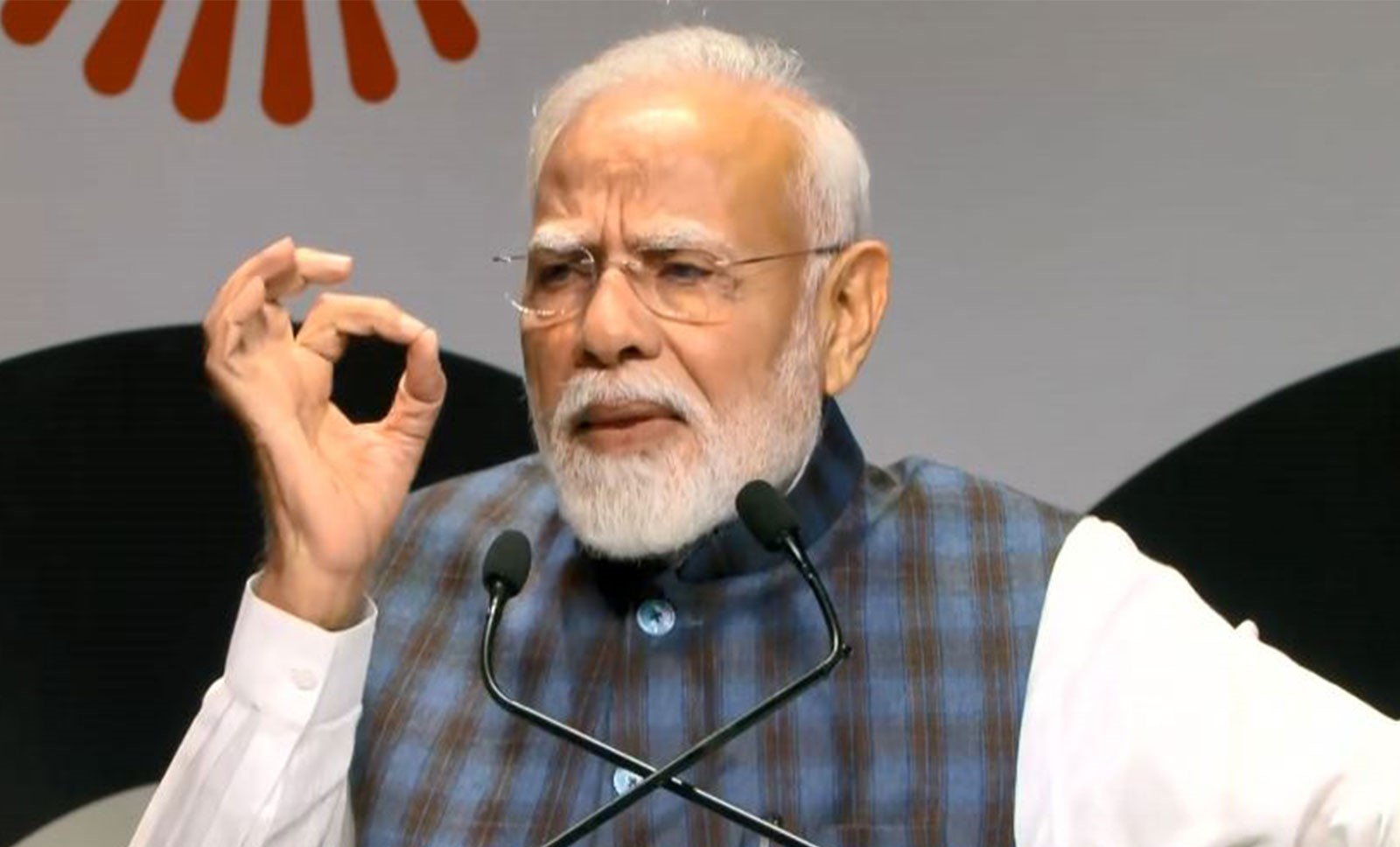
Prime Minister Narendra Modi on Thursday urged Indian industry leaders to make “India First” the guiding principle of their long-term investment decisions, citing the country’s progress in lifting around 500 million people out of poverty over the past 12-13 years.
Addressing the annual general meeting and convention of the Federation of Indian Chambers of Commerce and Industry (FICCI) at Bharat Mandapam in New Delhi, PM Modi said India’s rapid economic growth and the pace of poverty reduction reflected the country’s progress in the right direction.
“Today, the pace of progress in India is very fast. At the same time, the pace at which people are moving out of poverty is also very fast. The latest World Bank report is a source of pride for all of us. The report says that in just 12–13 years, 500 million people in India have overcome poverty,” he said.
Referring to FICCI’s centenary, the Prime Minister described the occasion as special and praised the industry body for remaining active and adapting to changing times.
“Before this, I have had the opportunity several times to attend and be a part of programs associated with FICCI. But today’s occasion is rather special,” he said.
“FICCI is completing 100 years since its establishment. For an institution to remain consistently vigilant and active for 100 years, to propel itself forward with changing times, and to continue playing an active role in the nation’s economic journey–this is a tremendous achievement,” PM Modi said.
He also appreciated everyone associated with the organisation over the years and extended his best wishes to its members.
Recounting different phases of India’s economic journey, PM Modi referred to the era of the “License Quota Raj”, nationalisation and the period when the country was counted among the “Fragile Five” economies.
“Over the past 100 years, India’s economy has witnessed several phases. We have seen the era of the ‘License Quota Raj’, the failed experiment of nationalisation, and a time in the 21st century when India’s economy was counted among the ‘Fragile Five’. However, over the last 12 years, our youth, farmers, workers and industry leaders have worked hard to transform this situation,” he said.
Taking a swipe at the policies pursued during the period when the slogan “Garibi Hatao” (Eradicate Poverty) was raised in the 1970s, the Prime Minister said poverty could have been eradicated at the time, but shortcomings in policy and intent had prevented it.
“In the 1970s, when the slogan ‘Garibi Hatao’ (Eradicate Poverty) was raised in the country, India’s population was only about 500 million. Poverty could have been eradicated then too, but FICCI is also a witness to the fact that there were shortcomings in policies at the time, and unfortunately, in intent as well,” he said.
PM Modi said efforts made with the right intent had helped lift around 500 million people out of poverty over the past 12-13 years. He added that the country’s current development trajectory would contribute to its future success.
Describing India as the world’s fastest-growing major economy, the Prime Minister said leading institutions projected growth of around 7 per cent.
He urged industry leaders to assess the potential of Indian businesses over the next two decades and increase their contribution to the goals of Viksit Bharat and Atmanirbhar Bharat.
“Over its 100 years, FICCI has seen the country’s industry achieve a great deal. Now is the time to decide what Indian industry can achieve in the next 20 years–how you can further increase your contribution to the journey of Viksit Bharat (Developed India) and Atmanirbhar Bharat (Self-Reliant India),” he said.
The Prime Minister cautioned businesses against focusing only on established sectors that offered short-term returns, urging them to prepare for emerging requirements in India and global markets.
“However, industry will also have to prepare for the demands that will emerge in the future at both the national and global levels. And we must work on those capabilities–in this era of the weaponisation of resources, securing the nation’s future becomes the responsibility of all of us,” he said.
Calling on industry leaders to prioritise national interests, PM Modi said “India First” should guide every long-term investment decision over the next 20 years.
“And therefore, I have one request for you: in every long-term investment decision you make over the next 20 years, make ‘India First’ your foundation. This will make the country self-reliant, and new opportunities will also open up for the growth of your businesses,” he said.
The World Bank’s October 2026 Poverty and Equity Brief said around 496 million people in India had moved above the lower-middle-income poverty line of USD 4.20 per day between 2011 and 2023.
According to the report, the share of the population living below this poverty line declined from 57.7 per cent to 16.1 per cent during the period. Extreme poverty, measured at USD 3 per day, also fell from 27.1 per cent to 2.6 per cent.
The World Bank attributed the decline to strong consumption growth, rising employment, particularly among women, and expanded social transfers, including food subsidies. It also reported that employment increased by 13.4 crore between 2017 and 2023, with much of the growth driven by rural women entering paid work.
The FICCI convention, themed “Bharat 2047”, has brought together more than 2,500 delegates, including industry leaders, chief executives, ambassadors, diplomats and policymakers. The sessions focus on India’s economic growth, global competitiveness, the next phase of reforms, manufacturing and the potential of artificial intelligence. The event also provides young innovators an opportunity to present their ideas to investors and industry leaders.
FICCI’s centenary year is 2026-27, with the organisation set to complete 100 years on April 7, 2027. Founded in 1927, the industry body represents more than 2.5 lakh companies, directly and through over 300 affiliated regional and state-level industry associations. It also has partnership agreements with 250 national business associations across more than 100 countries, according to the Prime Minister’s Office.
(ANI Inputs)