








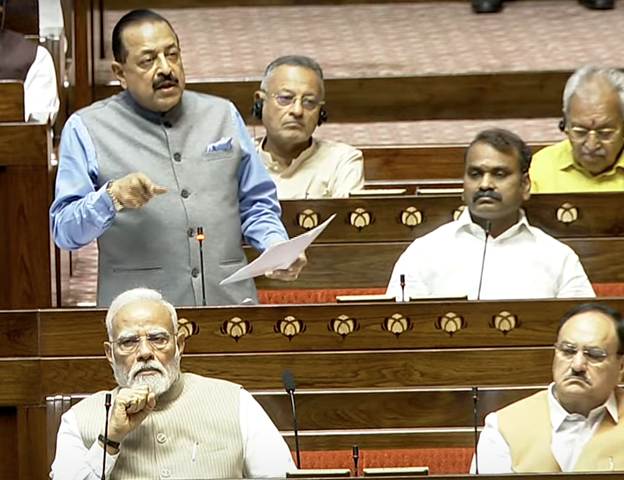
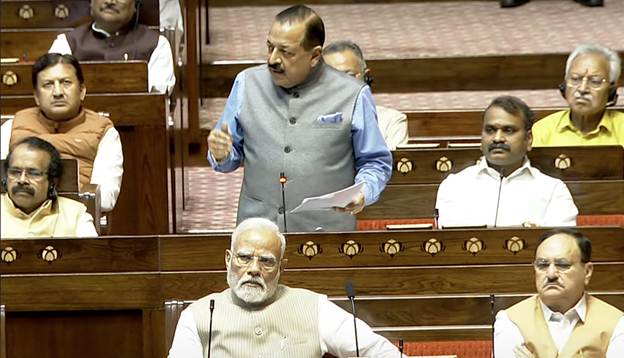
Union Minister of State for Science and Technology, Jitendra Singh, on Thursday praised India’s newly launched “Nuclear Mission,” calling it a transformative step towards meeting the country’s growing energy demands while providing a clean, stable power source.
Referencing Homi Bhabha, the visionary behind India’s nuclear program, Singh highlighted that the mission reaffirms Bhabha’s stance on peaceful nuclear development.
“When Homi Bhabha launched India’s Nuclear programme, there was widespread scepticism about India’s allegedly hidden designs, and Homi Bhabha had sought to clear the air saying that India’s Nuclear programme was dedicated to peaceful purposes,” Singh told the Rajya Sabha.
He added, “Today, Homi Bhabha’s pledge stands vindicated by PM Narendra Modi with the launch of “Nuclear Mission” to meet India’s increasing requirements through environment friendly clean energy..”
Finance Minister Nirmala Sitharaman announced the Nuclear Energy Mission during her Budget speech on February 1, allocating ₹20,000 crore to the initiative. The mission aims to generate 100 gigawatts (GW) of nuclear energy by 2047, accounting for 10% of India’s total energy needs.
Singh emphasized the mission’s groundbreaking nature, especially the unprecedented decision to open the nuclear energy sector to private companies. This is a historic decision that breaks past taboos. The nuclear program has traditionally operated behind a veil of secrecy, but under the leadership of Prime Minister Narendra Modi, we have now paved the way for private sector participation,” he said.
He also noted the significant budgetary support for nuclear energy, with a 170% increase in the Department of Atomic Energy’s budget since 2014. The current budget includes ₹20,000 crore for the indigenous development of at least five Bharat Small Modular Reactors.
Singh emphasized that India is collaborating with countries such as France and the United States for nuclear technology advancements, while prioritizing indigenous research and development. He highlighted the role of the National Research Foundation, funded primarily by non-government sources, in accelerating nuclear research.
In alignment with India’s commitment to achieving net-zero carbon emissions by 2070, Singh described nuclear energy as a cornerstone of the country’s clean energy transition. “This mission will not only help us meet our climate commitments but also position India as a global leader in advanced nuclear technology,” he said.
The government’s nuclear expansion plan also includes harnessing India’s vast thorium reserves, which make up 21% of the world’s total. Singh pointed out that key projects like the Bhavini reactor and the Kudankulam nuclear plant, which faced delays before 2014, have gained significant momentum under the current administration.