Defence Minister Rajnath Singh on Tuesday underscored the need for greater jointness and integration among India’s Armed Forces to meet the demands of modern warfare, stressing that collaborative strength across services is no longer a matter of choice but a necessity for national security.
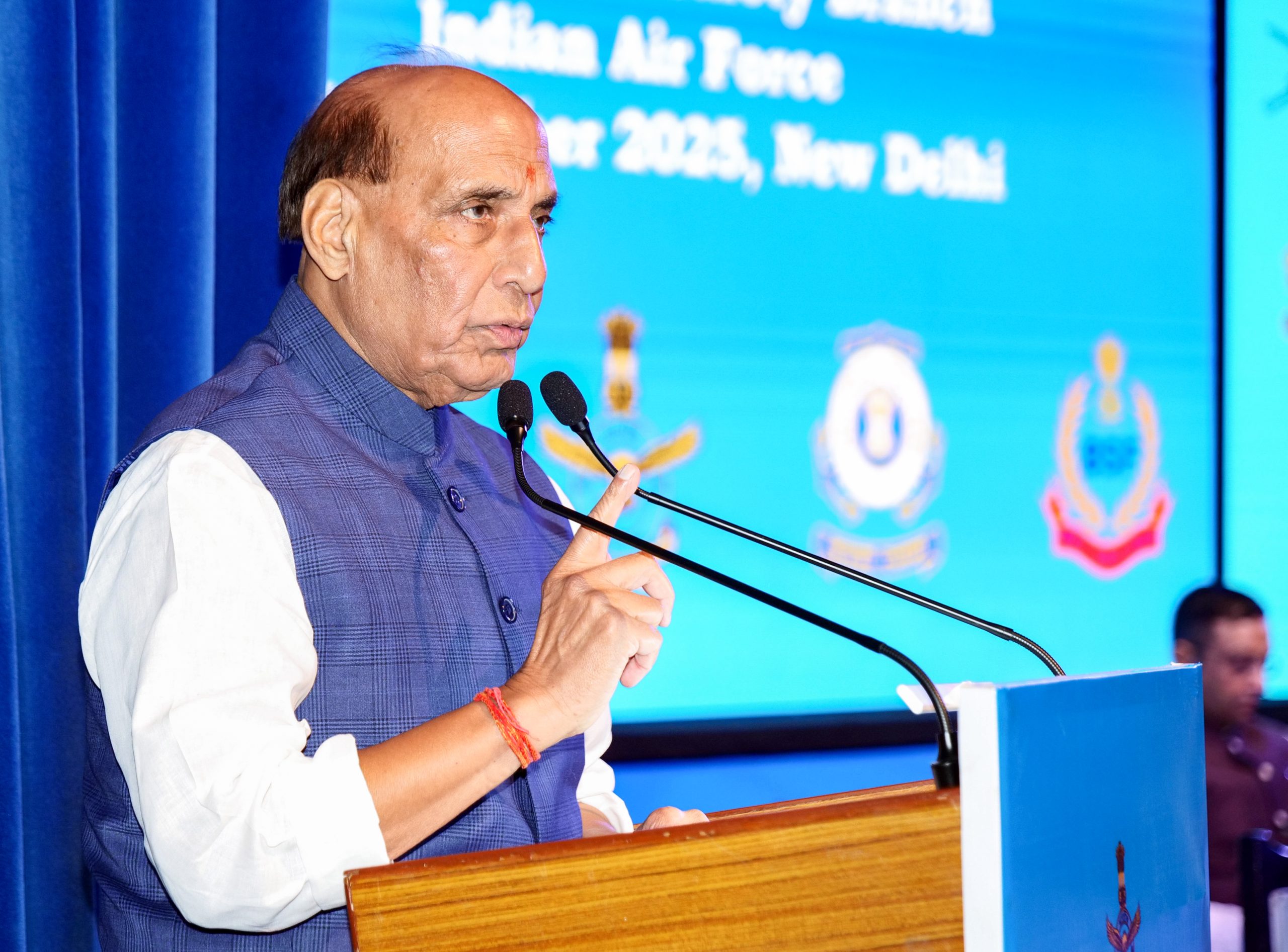
Speaking at a seminar organised by the Indian Air Force at Subroto Park, New Delhi, on the theme “Fostering Greater Jointness — Synergy through Shared Learning in the domain of Inspection and Audits, Aviation Standards and Aerospace Safety”, Singh said that the evolving character of warfare and the interplay of traditional and non-traditional threats demand a unified approach across land, sea, air, space, and cyberspace.
“Jointness has become a fundamental requirement for our national security and operational effectiveness today. While each of our services possesses the capacity to respond independently, the interconnected nature of domains makes collaborative strength the true guarantor of victory,” he said.
The Defence Minister recalled Prime Minister Narendra Modi’s remarks during the Combined Commanders’ Conference in Kolkata earlier this year, where the importance of jointness was underlined. He said this reflected the government’s commitment to ensuring that the Armed Forces remain rooted in values and traditions while becoming pioneers of future-ready systems.
Citing a practical example, Singh referred to Operation Sindoor, where the tri-services synergy produced a unified real-time operational picture. The IAF’s Integrated Air Command and Control System (IACCS), working in tandem with the Army’s Akashteer and the Navy’s Trigun, formed the joint operational backbone during the exercise. “It empowered commanders to take timely decisions, enhanced situational awareness, and reduced the risk of fratricide. This is the living example of jointness delivering decisive results and must become the benchmark for future operations,” he said.
Singh pointed to strides in the digital domain, citing the Army’s Computerised Inventory Control Group (CICG), the Air Force’s Integrated Materials Management Online System (IMMOLS), and the Navy’s Integrated Logistics Management System as examples of automation that had brought accountability and transparency. Work had now begun, he said, on a Tri-Services Logistics Application to integrate these platforms, provide shared visibility of stocks, and optimise cross-service resources.
He acknowledged that operational practices and inspection frameworks had evolved differently within each service based on unique experiences across terrains ranging from high-altitude mountains to deserts and deep seas. However, such knowledge often remained confined within individual services. “If the Army developed something, it remained with the Army. If the Navy or Air Force developed something, it remained within their own walls. This compartmentalisation has limited the cross-sharing of valuable lessons,” he added.
Urging the need to move beyond silos, the Defence Minister said interoperability was now essential for success in any conflict. He warned that divergence in critical areas such as aviation safety and cyber defence could prove disastrous. “Even a minor error in inspection can create cascading effects. And if our cyber defence systems differ across services, adversaries can exploit the gap. We must close these vulnerabilities by harmonising our standards,” he stressed.
At the same time, he cautioned against imposing uniformity that overlooks the uniqueness of each force. “The cold of the Himalayas is not the same as the heat of the desert. The Navy faces challenges different from the Army and Air Force. Our task is to create a shared baseline that preserves uniqueness while building interoperability and trust,” he said.
Singh emphasised that achieving jointness would require not just structural reform but also a shift in mindset. Senior leadership, he said, must continuously communicate the value of integration while respecting traditions. “We will face challenges as we move towards jointness. But through dialogue, understanding and respect for traditions, we can overcome these hurdles,” he added.
He urged the Armed Forces to study international best practices and adapt them to Indian conditions. “We can learn from others, but our answers must be Indian answers shaped by our geography, our needs and our culture,” he said.