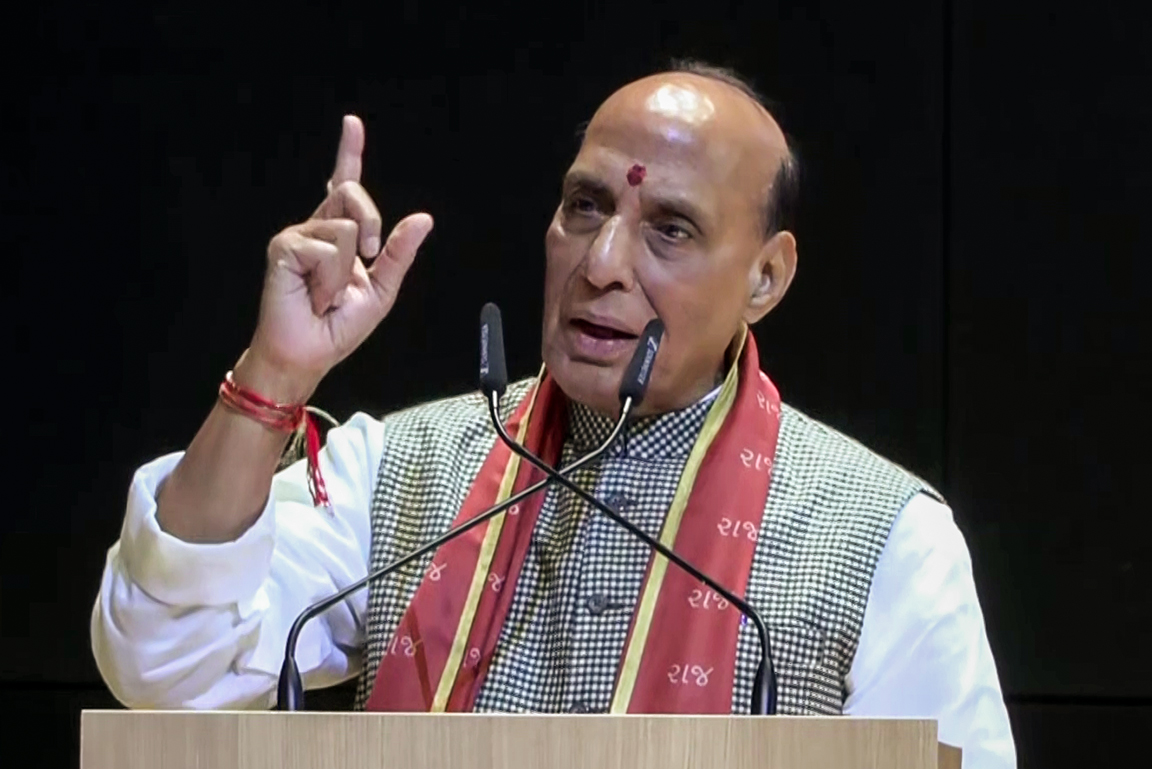
Defence Minister Rajnath Singh on Thursday said India halted Operation Sindoor on its “own terms” and was fully prepared for a prolonged conflict if required, while describing Pakistan as the “epicentre of international terrorism.”
Addressing the ANI National Security Summit 2.0, Singh underlined that India’s response to terrorism has fundamentally changed under the leadership of Narendra Modi, stressing a policy of “zero tolerance.”
Recalling Operation Sindoor, launched in response to the deadly Pahalgam terror attack that killed 26 people, the Defence Minister said the operation marked a turning point in India’s security approach. Emphasising the importance of deterrence in global politics, Singh described the operation as a “concrete manifestation” of India’s military strength.
“Bhay bin hoye na preet (There can be no love without fear). This captures the essence of deterrence,” he said, noting that while the operation lasted 72 hours, it was backed by extensive preparation and strengthened logistics.
On defence production, the minister said global confidence in India’s indigenous capabilities has grown, with several countries showing interest in its military equipment. He added that defence exports reached around Rs 39,000 crore in FY 2025–26, a rise of 62.66 per cent over the previous year.
Criticising Pakistan, Singh said terrorism must be tackled at operational, ideological and political levels, stressing the need to dismantle the ecosystem that sustains it.
“The true roots of terrorism lie in its ideological and political support systems,” he said, adding that while India is the hub for Information Technology, Pakistan has gained notoriety as a hub of “International Terrorism.”
Singh also dismissed nuclear threats during the operation, saying that India “did not fall for the bluff.”
Further, the Defence Minister warned against attempts to justify terrorism on religious or ideological grounds, calling such narratives dangerous and enabling. “Such justification acts like cover fire for terrorists,” he said.
Addressing broader geopolitical challenges, Singh pointed to rising instability across Europe and West Asia, noting that conflicts and strategic rivalries are reshaping the global order. He warned that technology, supply chains, and digital tools are increasingly being weaponised, while international institutions are weakening.
“The world is moving towards a ‘new world order’ that often appears to be a world with no order. India must move forward with greater alertness,” he said.
Calling for a balanced global framework, Singh emphasised the need for a system that ensures dignity, prevents conflicts, and avoids escalation into destruction.
(ANI)