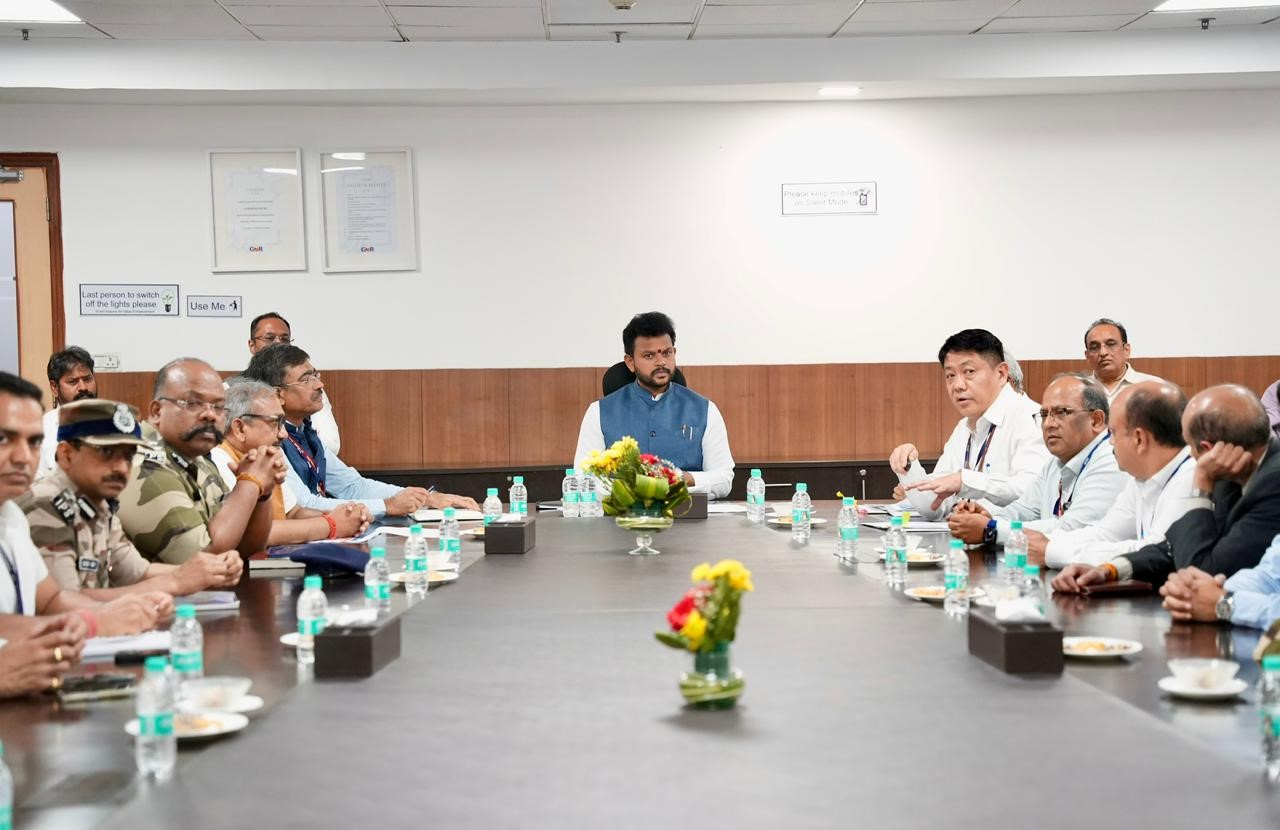
Civil Aviation Minister Ram Mohan Naidu on Thursday chaired a high-level stakeholder meeting at Delhi airport to review preparedness for the implementation of hub-and-spoke operations, a key pillar of India’s aviation growth strategy.
The meeting brought together senior officials from the Ministry of Civil Aviation, Ministry of Home Affairs, Bureau of Immigration, Bureau of Civil Aviation Security, Customs, Airports Authority of India, Directorate General of Civil Aviation, CISF, DigiYatra, Delhi International Airport Limited, and leading airlines.
The minister also conducted an on-ground inspection at Terminal 3 of Indira Gandhi International Airport, reviewing passenger flow systems and the Security Hold Area (SHA) to assess operational readiness.
The initiative aligns with the National Civil Aviation Policy 2016, which aims to position India as a global aviation hub by 2047. Officials said the government has developed an International Aviation Hub Strategy that includes calibrated allocation of Points of Call for foreign carriers, renegotiation of bilateral agreements to benefit Indian airlines, and liberalisation of domestic code-share arrangements.
“India’s unique geographical location between the eastern and western hemispheres provides a natural advantage in emerging as a global transit hub,” Naidu said, crediting support from Union Home Minister Amit Shah for advancing the proposal.
The hub-and-spoke model is expected to connect Tier-II and Tier-III cities—many developed under the UDAN scheme—with global destinations via major airports. It is also aimed at reducing travel time for passengers while ensuring optimal use of existing infrastructure.
At present, nearly 35 per cent of international passengers from India transit through foreign hubs such as Dubai, London, and Singapore. The government plans to reverse this trend by strengthening domestic hubs including Delhi, Mumbai, Bengaluru, Hyderabad, Kolkata and Chennai.
Highlighting Delhi airport’s role, Naidu noted that it has a capacity exceeding 100 million passengers annually, handles nearly half of northern India’s passenger traffic, and manages around 50,000 daily transfers, making it a natural hub.
The strategy also focuses on enhancing India’s air cargo capabilities through measures such as eliminating re-screening requirements for transshipment cargo and digitising documentation processes to improve efficiency.
Officials said the model could generate around 16 million direct and indirect jobs and contribute nearly $1.4 trillion to the economy by 2047.
Under the proposed system, passengers from smaller cities will be routed through hub airports for international travel. Customs and immigration formalities for outbound passengers will be completed at the first point of departure—the spoke airport—while inbound processes will occur at the final destination.
Baggage transfers will be handled seamlessly at hub airports without passenger intervention, and separate aircraft will be deployed for domestic and international segments to maintain operational clarity.
The government said the initiative will also improve aircraft utilisation for airlines, reduce congestion at major airports, and strengthen India’s position as a global aviation hub.