Print

Revival of Nalanda marks beginning of India’s ‘Golden Age’: PM Modi

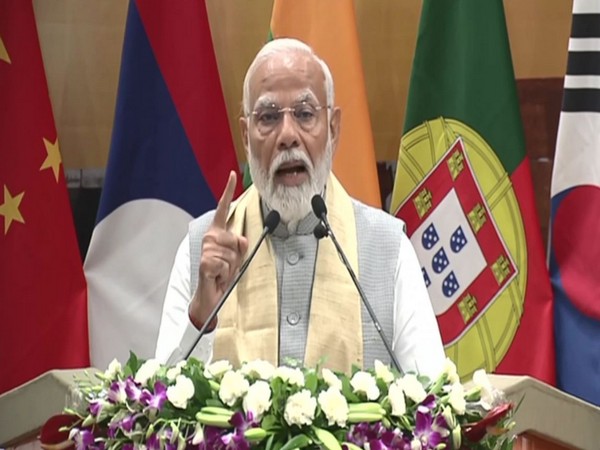
As he inaugurated the new campus of Nalanda University in Bihar on Wednesday, Prime Minister Narendra Modi emphasized the historical connection, saying that it marks the beginning of India’s ‘Golden Age.’

The new university campus closely replicates the ancient Nalanda University, whose ruins PM Modi visited earlier in the day.

Established around 1600 years ago, the ancient Nalanda is considered one of the first residential universities in the world.

Prime Minister Narendra Modi said that the new campus will showcase India’s capabilities to the world.

“Nalanda is more than just a name, it’s a mantra, an identity, a declaration that books might get destroyed by fire, but knowledge endures. The revival of Nalanda will mark the beginning of the Golden Age of India,” PM Modi said.

He expressed his happiness in visiting Nalanda within 10 days of being sworn in as prime minister for a third consecutive term.

Highlighting the historical significance of Nalanda, PM Modi said it symbolizes the renaissance of India’s past and reflects the heritage of various countries, including those in Asia.

“Nalanda was once the epicentre of India’s educational identity. Education goes beyond the realms of borders, profits and losses. Education shapes our thoughts and behaviour. During ancient times, admission to Nalanda University was not based on the nationality of the student. People from different walks of life used to come here in pursuit of education,” PM Modi said.

Highlighting International Yoga Day which is celebrated on June 21, the Prime Minister said that it has turned into a global celebration.

Stressing that India has maintained a balance between economic growth and environmental sustainability, PM Modi said that he is committed to transforming the country into a center of education and knowledge.

Nalanda University’s new campus has two academic blocks with 40 classrooms, with a total seating capacity of around 1,900. It includes two auditoriums with a capacity of 300 seats each, a student hostel for around 550 students, an international center, an amphitheater that can accommodate up to 2,000 individuals, a faculty club, and a sports complex, among other facilities.

The campus is a ‘Net Zero’ Green Campus. It is self-sustaining with solar power, domestic and drinking water treatment plants, a water recycling plant for reusing wastewater, 100 acres of water bodies, and many other environment-friendly facilities.

The university is conceived as a collaboration between India and East Asia Summit (EAS).

(With ANI input)
RELATED ARTICLES

13/09/26 | 6:41 pm | Droupadi Murmu

President Murmu extends greetings on eve of Ganesh Chaturthi

President Droupadi Murmu on Sunday extended her heartfelt greetings and best wishes to Indians in the country and abroad on the eve of Ganesh Chaturthi. In her message, the President said that Bhagwan Ganesha symbolises wisdom, prosperity and auspic...

09/09/26 | 5:09 pm | Arunachal Pradesh

‘Tribal communities are partners in building India’s future’: Vice President Radhakrishnan at Nyedar Namlo in Itanagar

Vice President C. P. Radhakrishnan on Wednesday visited Nyedar Namlo in Itanagar, a sacred place of worship and community centre associated with the indigenous Donyi-Polo faith of the Nyishi community and other indigenous groups of Arunachal Pradesh....

08/09/26 | 5:51 pm | Bhaderwah Valley

Kailash Kund Yatra begins in J&K’s Doda, devotees join from adjoining districts

The annual three-day Kailash Kund Yatra commenced on Tuesday in the Bhaderwah Valley of Jammu and Kashmir’s Doda district, with the sacred ‘Charri Mubarak’ departing from the ancient Vasuki Nag Temple at Gatha, officials said. The pilgrimage a...

19/06/24 | 3:19 pm

Print

Revival of Nalanda marks beginning of India’s ‘Golden Age’: PM Modi

As he inaugurated the new campus of Nalanda University in Bihar on Wednesday, Prime Minister Narendra Modi emphasized the historical connection, saying that it marks the beginning of India’s ‘Golden Age.’

The new university campus closely replicates the ancient Nalanda University, whose ruins PM Modi visited earlier in the day.

Established around 1600 years ago, the ancient Nalanda is considered one of the first residential universities in the world.

Prime Minister Narendra Modi said that the new campus will showcase India’s capabilities to the world.

“Nalanda is more than just a name, it’s a mantra, an identity, a declaration that books might get destroyed by fire, but knowledge endures. The revival of Nalanda will mark the beginning of the Golden Age of India,” PM Modi said.

He expressed his happiness in visiting Nalanda within 10 days of being sworn in as prime minister for a third consecutive term.

Highlighting the historical significance of Nalanda, PM Modi said it symbolizes the renaissance of India’s past and reflects the heritage of various countries, including those in Asia.

“Nalanda was once the epicentre of India’s educational identity. Education goes beyond the realms of borders, profits and losses. Education shapes our thoughts and behaviour. During ancient times, admission to Nalanda University was not based on the nationality of the student. People from different walks of life used to come here in pursuit of education,” PM Modi said.

Highlighting International Yoga Day which is celebrated on June 21, the Prime Minister said that it has turned into a global celebration.

Stressing that India has maintained a balance between economic growth and environmental sustainability, PM Modi said that he is committed to transforming the country into a center of education and knowledge.

Nalanda University’s new campus has two academic blocks with 40 classrooms, with a total seating capacity of around 1,900. It includes two auditoriums with a capacity of 300 seats each, a student hostel for around 550 students, an international center, an amphitheater that can accommodate up to 2,000 individuals, a faculty club, and a sports complex, among other facilities.

The campus is a ‘Net Zero’ Green Campus. It is self-sustaining with solar power, domestic and drinking water treatment plants, a water recycling plant for reusing wastewater, 100 acres of water bodies, and many other environment-friendly facilities.

The university is conceived as a collaboration between India and East Asia Summit (EAS).

(With ANI input)