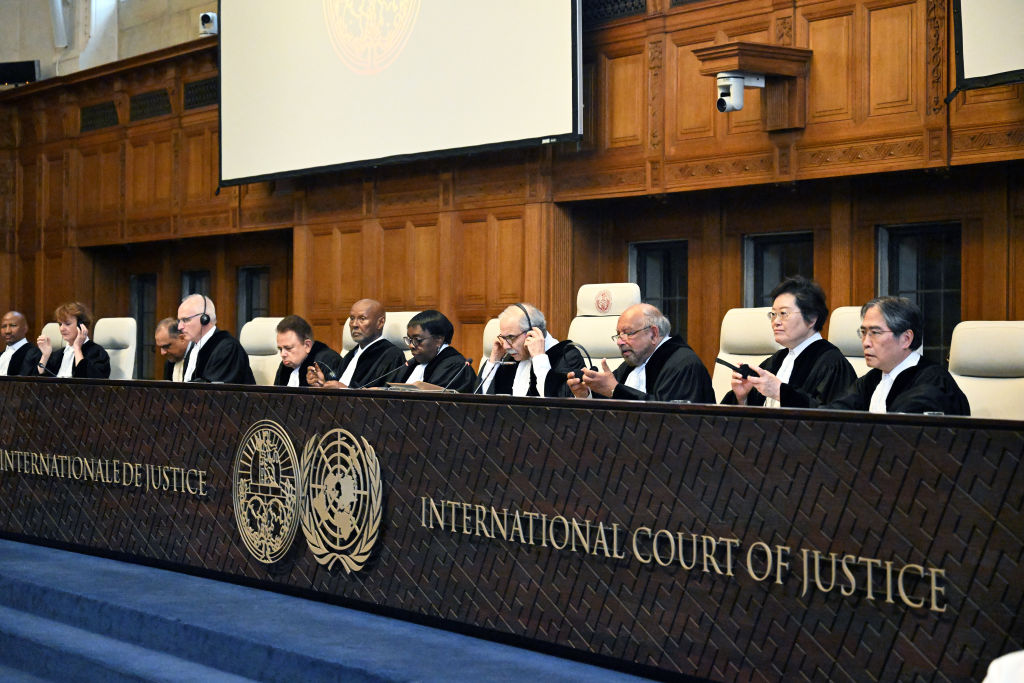
The World Court concludes hearings on Friday on countries’ legal obligation to fight climate change and whether large states contributing most to greenhouse-gas emissions may be liable for damage caused to small island nations.
The International Court of Justice will issue an opinion on those questions, likely in 2025, that could be cited in climate change-driven litigation around the world.
During two weeks of hearings, rich countries of the global north broadly argued that existing climate treaties like the Paris Agreement, which are largely non-binding, should be the basis for deciding countries’ responsibilities.
For their part, developing nations and small island states bearing the brunt of climate change sought robust measures to curb emissions, and want to regulate financial support from wealthy polluting nations.
“On the current trajectory of greenhouse gas emissions, Tuvalu will disappear completely beneath the waves”, Eselealofa Apinelu, representing the small island state, told the judges.Nearly 100 states and organisations took part in hearings at the institution, the top U.N. court for disputes between states, where small island nations had spearheaded the efforts to get the U.N. General Assembly to ask for an advisory opinion.
World Court opinions are not binding, but carry legal and political weight. Experts say the court’s opinion on climate change could set a precedent in climate change-driven lawsuits in courts from Europe to Latin America and beyond.
“The power of an ICJ opinion does not lie only in its direct enforcement, but in the clear message and guidance it will send to the many courts around the world that are grappling with the question of state obligations to address the climate emergency and remedy climate harm,” Nikki Reisch, director of the Center for International Environmental Law’s Climate & Energy Program, told Reuters.
The hearings opened in early December with Pacific island nation Vanuatu, which urged judges to recognise and repair the harm caused by climate change.
The world’s largest emitters, the U.S. and China, together with countries like Saudi Arabia and several EU members, argued that existing treaties produced by U.N.-backed climate change negotiations, which are largely non-binding, should be the benchmark in determining states’ obligations.
“China hopes that the court will uphold the U.N. climate change negotiations mechanism as the primary channel for global climate governance,” Ma Xinmin, a legal adviser in China’s foreign ministry, told the court.
Under the Paris Agreement, countries have to update their national climate plans, known as Nationally Determined Contributions (NDCs), every few years with the next round due by February 2025.
The UN has asked countries to deliver economy-wide plans that show an increased, non-binding ambition to hold the world to 1.5C (2.7F) of warming.
“NDCs concern an obligation of best efforts, not of results,” a Saudi Ministry of Energy representative told the court, in comments that worried those arguing for binding rules to curb fossil fuel use.
(Reuters)