





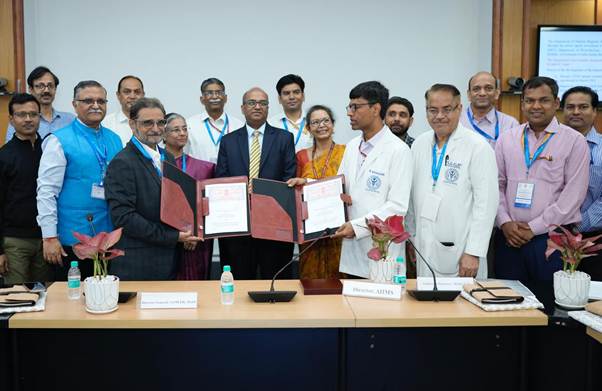
The Society for Applied Microwave Electronics Engineering & Research (SAMEER) and AIIMS on Tuesday signed a significant Memorandum of Understanding (MoU) to collaborate on the development of advanced medical devices. The partnership aims to drive advancements in high-field and low-field Magnetic Resonance Imaging (MRI) and Nuclear Magnetic Resonance (NMR) systems. Additionally, the collaboration will focus on research in Radio Frequency (RF) and microwave technologies, all with the goal of enhancing medical applications and fostering innovation in the healthcare sector. The MoU was signed on the occasion of the 32nd Foundation Day of the Department of NMR at AIIMS, New Delhi.
The MoU outlines a range of research and development efforts. One of the key areas of focus will be the collaborative development of medical devices, with a particular emphasis on clinical validation of the indigenous 1.5 Tesla MRI system, developed by SAMEER, Mumbai. Additionally, the two institutions will explore the potential of Artificial Intelligence (AI) and Machine Learning (ML) for image enhancement and accelerated imaging. The design and development of subsystems for both high and low-field MRI scanners, as well as RF subsystems for high-field animal MRI scanners, are also part of the agreement.
This collaboration builds upon India’s goal of achieving self-reliance in MRI technology. SAMEER, Mumbai, has been at the forefront of the Indigenous Magnetic Resonance Imaging (IMRI) project, which is supported by the Ministry of Electronics and Information Technology (MeitY). The project aims to design, develop, and test an indigenous 1.5 Tesla MRI system for medical imaging, with collaboration from organizations such as C-DAC (Trivandrum and Kolkata), IUAC (New Delhi), and DSI-MIRC (Bangalore).
Key developments in this national mission include the creation and integration of critical subsystems, such as RF Power Amplifiers, High Power T/R Switches, RF Spectrometers, RF Coils, Rx. Front Ends, control units, and specialized software. After completing animal trials successfully, the 1.5 Tesla magnet, including its superconducting components, quench protection system, and associated control electronics, has been ramped up to 1.5 Tesla. Final cryotesting is currently underway, with integration of the complete system on the horizon.
As part of the MoU, clinical validation of this indigenous MRI technology will be conducted at AIIMS, New Delhi. This marks a significant milestone in India’s pursuit of self-reliance in medical device technology.