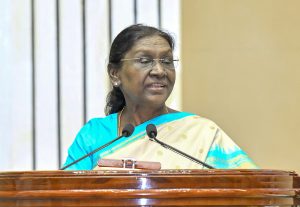
Leading scientists and policymakers on Saturday underscored the need for stronger science–policy convergence to efficiently translate research outcomes into real-world applications, aligning India’s scientific ecosystem with the vision of Viksit Bharat.
Chairing the National Science Day Lectures at the National Science Day Celebration–2026 held at Vigyan Bhawan in New Delhi, Principal Scientific Adviser to the Government of India Prof. Ajay K. Sood said that scientific advancement must be closely integrated with national missions and policy direction.
The event, organised under the theme “Women in Science Catalysing Viksit Bharat,” featured three keynote lectures and a panel discussion on the Science Policy Interface for Catalysing Viksit Bharat. It brought together policymakers, researchers, academicians and industry representatives to deliberate on strengthening India’s research-to-application pipeline.
Prof. Sood stressed that strategic sectors such as aerospace, defence, critical metals, advanced materials and digital communications require coordinated institutional mechanisms and sustained research investments. “The science-policy interface plays a decisive role in translating scientific capabilities into national strength,” he said, adding that research, innovation and policy frameworks must function in synergy.
He also highlighted the importance of building indigenous technological capacity and fostering interdisciplinary collaboration. Emphasising inclusive outreach, he called for greater communication of science in Indian languages to enhance public engagement.
Prof. Abhay Karandikar, Secretary of the Department of Science and Technology (DST), said India’s science policy architecture must support both frontier research and translational innovation. He noted that the government is committed to enabling interdisciplinary research and strengthening institutional collaborations in emerging technologies.
Science-led development, he said, must ensure that research outcomes move efficiently from laboratories to industry and society. He further stressed the need to empower researchers—particularly women scientists—and to build inclusive research ecosystems for sustained national progress.
During the panel discussion, Prof. Shekhar C. Mande, President of the Indian National Science Academy (INSA), emphasised the importance of sustained dialogue between scientists and policymakers. He said evidence-based policymaking must be grounded in rigorous research and scientific expertise, adding that stronger institutional interfaces between academia and government are critical for achieving long-term development goals.
Among the keynote speakers, Shashi S. Vempati, former CEO of Prasar Bharati, spoke on “Direct to Mobile Broadcasting: India’s Next Digital Leapfrog.” He traced Doordarshan’s evolution across various ICT phases and highlighted ongoing collaboration with IIT Kanpur and a startup partner to advance direct-to-mobile broadcasting.
Dr. K. Balasubramanian, Director of the Non-Ferrous Technology Development Centre (NFTDC), outlined an integrated roadmap for critical metals and materials. He called for a shift from traditional serial lab-to-plant development to a mission-mode, systems-based approach, especially in strategic sectors such as space, defence and nuclear energy.
Dr. Shubha V. Iyenger, former Distinguished Scientist at CSIR–National Aerospace Laboratories, delivered a lecture on “Made in India Technologies for Aerospace and Defence.” She highlighted “Drishti,” India’s first indigenous runway visibility measuring system, for which she was conferred the Padma Shri in 2026.
The event concluded with a collective resolve to deepen science–policy integration, accelerate innovation cycles and strengthen public engagement with science, as India advances towards its long-term development objectives under the Viksit Bharat vision.