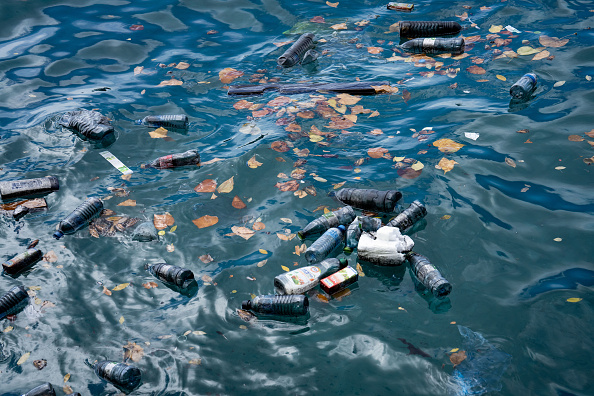
Researchers in Japan have developed a plastic that dissolves in seawater within hours, offering up a potential solution for a modern-day scourge polluting oceans and harming wildlife.
While scientists have long experimented with biodegradable plastics, researchers from the RIKEN Center for Emergent Matter Science and the University of Tokyo say their new material breaks down much more quickly and leaves no residual trace.
At a lab in Wako city near Tokyo, the team demonstrated a small piece of plastic vanishing in a container of salt water after it was stirred up for about an hour.
While the team has not yet detailed any plans for commercialisation, project lead Takuzo Aida said their research has attracted significant interest, including from those in the packaging sector.
Scientists worldwide are racing to develop innovative solutions to the growing plastic waste crisis, an effort championed by awareness campaigns such as World Environment Day taking place on June 5.
Plastic pollution is set to triple by 2040, the UN Environment Programme has predicted, adding 23-37 million metric tons of waste into the world’s oceans each year.
“Children cannot choose the planet they will live on. It is our duty as scientists to ensure that we leave them with best possible environment,” Aida said.
Aida said the new material is as strong as petroleum-based plastics but breaks down into its original components when exposed to salt. Those components can then be further processed by naturally occurring bacteria, thereby avoiding generating microplastics that can harm aquatic life and enter the food chain.
As salt is also present in soil, a piece about five centimetres (two inches) in size disintegrates on land after over 200 hours, he added.
The material can be used like regular plastic when coated, and the team are focusing their current research on the best coating methods, Aida said. The plastic is non-toxic, non-flammable, and does not emit carbon dioxide, he added.
(Reuters)