








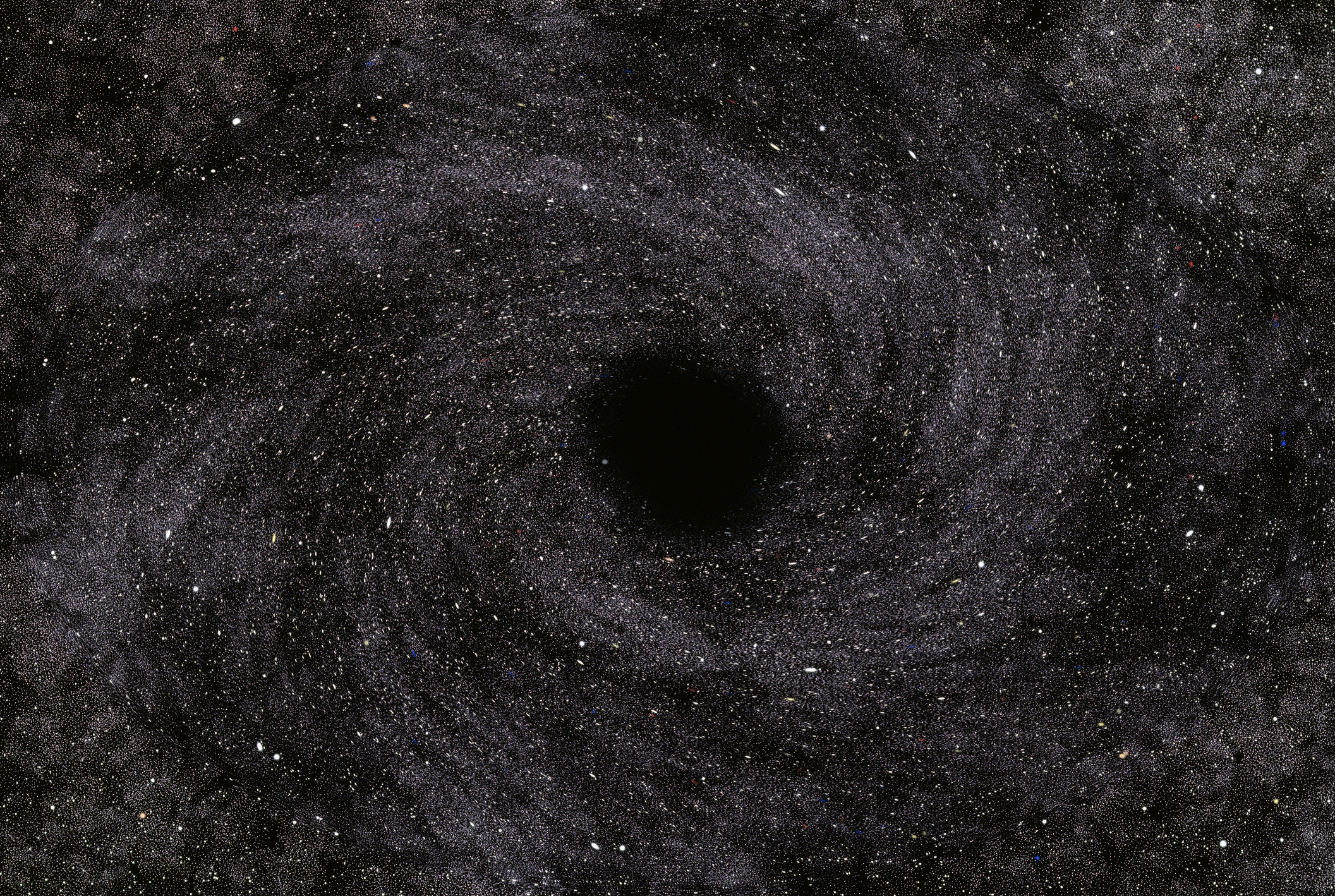
At the center of the Milky Way galaxy resides a supermassive black hole four million times the mass of our sun called Sagittarius A* that some scientists have called a gentle giant because of its quiescence. But someday it could become a beast.
Researchers said on Tuesday they have observed in real time a dramatic brightening at the heart of another galaxy apparently caused by a supermassive black hole awakening from dormancy and beginning to gorge itself with nearby material. It marks the first time this awakening process has been seen as it happens.
Earth-based and orbiting telescopes were used to track the events unfolding at the core of a galaxy called SDSS1335+0728, located roughly 360 million light-years from Earth in the constellation Virgo. A light year is the distance light travels in a year, 5.9 trillion miles (9.5 trillion km).
Black holes are extraordinarily dense objects with gravity so strong that not even light can escape. They range in size from a mass equivalent to a single star to the behemoths existing at the core of many galaxies, millions and even billions of times more massive. Galaxy SDSS1335+0728’s supermassive black hole has a mass about one million times the mass of the sun.
The environment around a supermassive black hole can be extraordinarily violent, as it shreds stars and gulps any other material within its gravitational grasp. The researchers said it appears that a spinning disk of diffuse material has formed around the SDSS1335+0728 supermassive black hole, with some of the matter being consumed. Such a disk – called an accretion disk – radiates energy at very high temperatures, sometimes outshining an entire galaxy.
A bright and compact region such as this, powered by a supermassive black hole at the center of a galaxy, is called an “active galactic nucleus.”
“These nuclei are characterized by emitting large amounts of energy at a variety of wavelengths, from radio to gamma rays. They are considered one of the most luminous objects in the universe,” said astrophysicist Paula Sanchez Saez of the European Southern Observatory in Germany, lead author of the study published in the journal Astronomy & Astrophysics.
“Studying active galactic nuclei is crucial to understanding galaxy evolution and the physics of supermassive black holes,” Sanchez added.
This galaxy, with a diameter of around 52,000 light years and a mass equivalent to about 10 billion sun-sized stars, had been observed for decades before sudden changes were detected in 2019. The luminosity at the heart of the galaxy has been rising in observations since then.
Supermassive black holes sometimes shoot vast jets of high-energy particles into space, but no such jet has been detected in this instance, according to astrophysicist and study co-author Lorena Hernandez Garcia of the University of Valparaiso in Chile.
So what may have activated this supermassive black hole?
“At the moment, we do not know,” Sanchez said.
“It could be a natural process of the galaxy,” Hernandez added. “We know that a galaxy passes through different phases of activity and non-activity during its lifetime. Something might happen to make a galaxy activate, like, for example, a star that is falling to the black hole.”
If the observations represent something other than the onset of an active galactic nucleus, it would have to be an astrophysical phenomenon never before seen, according to the researchers.
Sagittarius A*, or Sgr A*, is located about 26,000 light-years from Earth. Could it, too, suddenly roar to life?
“The same process could eventually happen to Sgr A*, which is actually dormant. But for now we are not in risk, and probably if it activates we would not notice because we are very far from the center,” Hernandez said.
(Reuters)