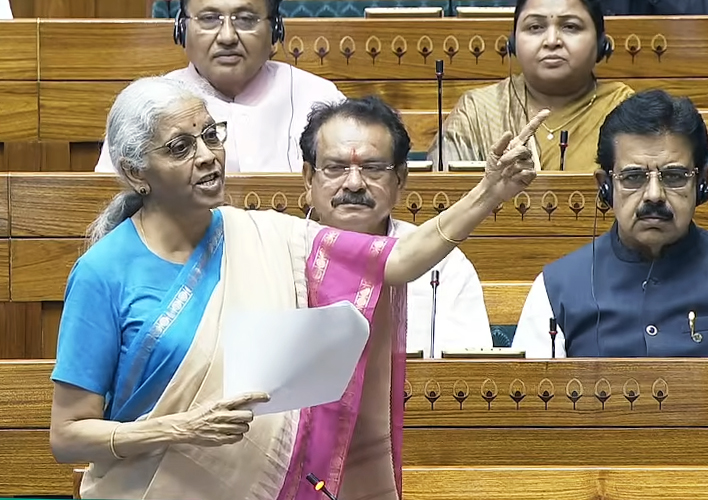
Union Finance Minister Nirmala Sitharaman on Friday presented the Second Batch of Supplementary Demands for Grants for 2025–26 in the Lok Sabha, proposing a gross expenditure of about ₹2.81 lakh crore.
The proposal includes cash, technical and token supplementary grants aimed at supporting defence expenditure, strengthening social security programmes and creating a fiscal buffer to manage global economic uncertainties.
Replying to the discussion in the House, Sitharaman said the proposal also includes ₹902 crore to recoup advances drawn from the Contingency Fund of India.
“This involves gross expenditure of about ₹2.81 lakh crore through cash, technical or token supplementaries. The present proposal also includes an amount of ₹902 crore that is being provided for recouping advances of an equivalent amount from the Contingency Fund of India,” the Finance Minister said.
She informed the House that ₹2.01 lakh crore has been proposed as cash supplementary across 18 grants, while ₹0.80 lakh crore has been sought as technical supplementary across 32 grants.
A significant portion of the allocation has been directed towards defence expenditure and rural employment programmes.
Sitharaman said ₹41,430.48 crore has been allocated for Defence Services (Revenue) under the supplementary demands.
“Under Prime Minister Modi’s government, efforts are being made to support and strengthen our soldiers. In these Supplementary Demands for Grants, the Opposition should extend support as funds are being allocated for defence and economic stability,” she said.
Addressing rural employment, the Finance Minister said that while ₹95,000 crore was initially allocated for MGNREGA (VB-G RAM-G), an additional ₹30,000 crore is now being provided under the supplementary demands.
“Our commitments for MGNREGA-VB-G-RAM G are being fulfilled,” she said.
The minister also announced the creation of an Economic Stabilisation Fund worth ₹57,381.84 crore, aimed at protecting the economy from external shocks.
Sitharaman said the introduction of supplementary demands does not indicate shortcomings in the original Budget but reflects a flexible fiscal approach to address emerging requirements.
She added that the government has limited such demands to two instances per year, keeping them to the “bare minimum”.
The Finance Minister also assured the House that the additional expenditure would remain within the fiscal deficit target announced in the Union Budget on February 1, 2026.
“We will, in no way, fail to fulfil the commitment made in the Budget. The assurances given in this House will remain within the fiscal deficit target,” she said.
Defending the need for a fiscal cushion, Sitharaman said the fund would provide the government with the necessary fiscal headroom to respond to supply chain disruptions and global economic uncertainties. (ANI)