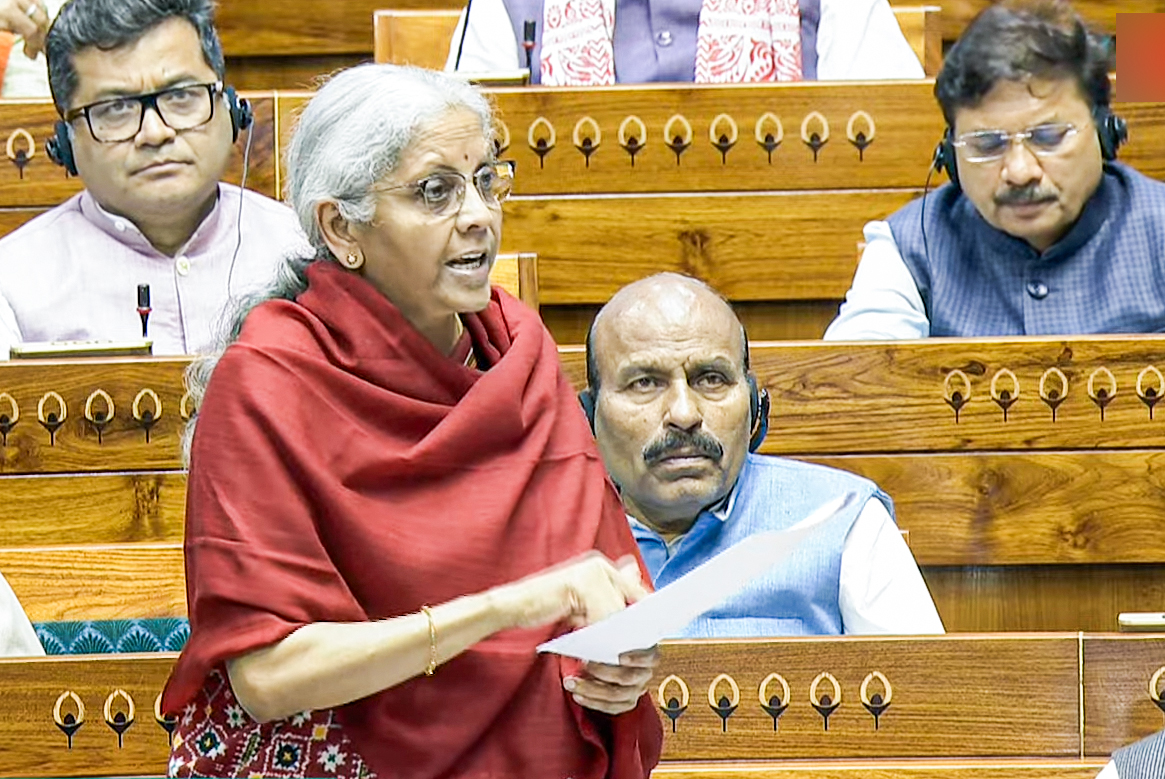
Finance Minister Nirmala Sitharaman introduced the new Income Tax Bill, 2025, in the Lok Sabha on Thursday as part of tax reforms aimed at streamlining and simplifying provisions to make them easier to understand and reduce the scope for legal disputes.
The legislation will replace the Income Tax Act, 1961, which has undergone extensive modifications over the past six decades.
The bill will be sent to the Select Committee of Parliament before being presented for final approval. The new law is expected to take effect on April 1, 2026.
The primary objective of the new Income Tax Bill is to simplify tax laws, making them more transparent, easier to interpret, and taxpayer-friendly. By replacing complex provisions with clearer language, it aims to reduce legal disputes and encourage voluntary tax compliance.
The bill may introduce lower penalties for certain offences, making the tax system more accommodating for taxpayers.
The Income Tax Bill has been condensed to 622 pages and contains 536 clauses. It will replace the existing 64-year-old law, which spans 823 pages with 819 sections. The proposed bill seeks to simplify legal language by introducing clearer terms, such as replacing “assessment year” with “tax year.” It also eliminates various convoluted provisions and explanations to enhance readability and reduce legal ambiguities. Additionally, certain archaic clauses are being removed as part of the simplification process.
The new bill also introduces explicit provisions for virtual digital assets and updates beneficial tax rates. This ensures that digital assets, such as cryptocurrency, are covered under a proper tax framework.
The bill will not alter existing tax slabs or revise the tax rebate structure. Instead, it focuses on making the six-decade-old legislation more user-friendly.
“This reform is a significant step toward modernizing India’s tax framework, bringing greater clarity and efficiency. The bill promises a more streamlined, accessible tax system, making it easier for citizens and businesses to fulfill their obligations while fostering trust in the system,” said Rohinton Sidhwa, Partner, Deloitte India.
The first part of the Budget Session of Parliament concluded on Thursday, with the second part scheduled to resume on March 10. The session is being held in two phases—January 31 to February 13 and March 10 to April 4.
-IANS