








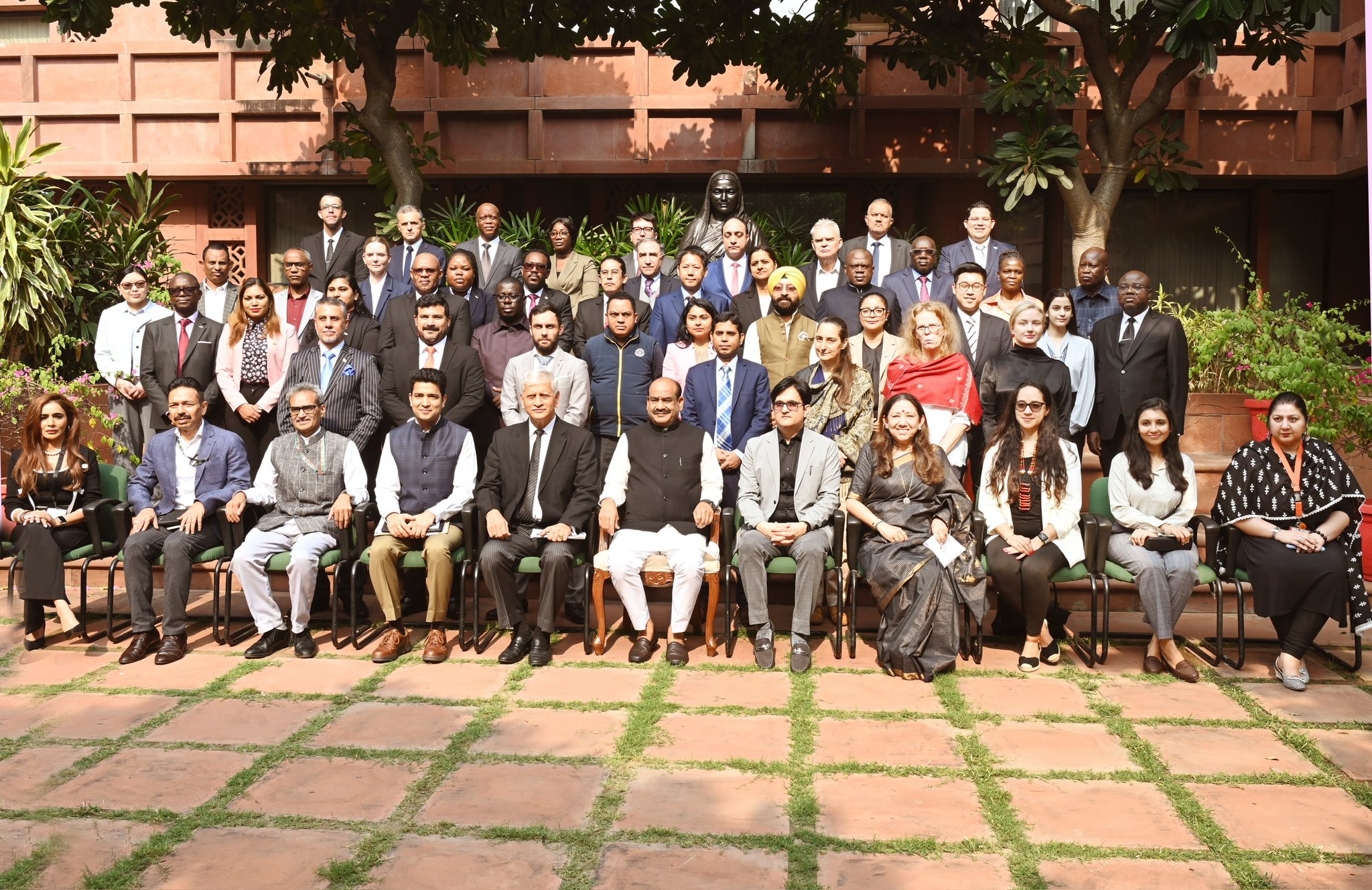
Lok Sabha Speaker Om Birla on Tuesday emphasized that the recently passed three new criminal laws were the result of extensive discussions in the House and the Standing Committee, alongside significant public engagement. Speaking to 135 diplomats and officials from 83 countries at a program organized by the Institute of Constitutional and Parliamentary Studies (ICPS) in Parliament, Speaker Birla asserted that these laws are designed to meet the challenges and expectations of contemporary society.
Former Chief Justice of India U.U. Lalit also spoke at the event, contributing to the discussions on India’s legal advancements.
Birla pointed out that the new laws have been crafted to reflect advancements in technology and the evolving nature of crimes. He highlighted the importance of justice in India, saying, “The law of India gives the right to justice to the last person,” and noted that the public holds judges in high regard, viewing them as embodiments of justice. He expressed that the faith in the justice system has grown stronger over the past 75 years.
In his address, he underscored the necessity for diplomats to grasp the legal framework and values of various nations, which he believes enhances diplomatic effectiveness and fosters mutual understanding. “It is crucial to understand India’s legal structure, Parliament proceedings, and our democratic system,” he added.
Reflecting on the last 75 years, Birla remarked on the increasing public confidence in India’s legislative process, attributing this to the nation’s commitment to transparency, accountability, and inclusiveness. He said that lawmakers have diligently worked to address the changing needs of society, creating laws that protect rights, promote justice, and foster economic development. “This increased confidence underscores a healthy democracy,” he added.
Birla also emphasized the importance of gender equality in the new laws, describing it as foundational to the country’s constitutional framework and a guiding principle for the world. He reiterated that Indian laws are reflective of the country’s international commitments, highlighting India’s respect for international law and its advocacy for human rights.
He concluded that India’s legal system serves as a tool for empowerment, addressing issues from gender equality to environmental protection and anti-discrimination. In referencing India’s strong tradition of arbitration, he said that it has been a respected practice throughout the nation’s history.