The Telecommunication Engineering Centre (TEC), the technical arm of the Department of Telecommunications (DoT), has signed a Memorandum of Understanding with the Indian Institute of Technology Kharagpur to collaborate on joint studies, research and technical contributions in advanced telecom technologies and global standardisation efforts.
Under the partnership, the two institutions will work together to develop India-specific standards for future networks, including 6G, optical communications and non-terrestrial networks (NTNs). The collaboration also covers key telecom technologies such as Passive Optical Networks, advanced antenna systems, MIMO technologies for 5G and future wireless networks, and electromagnetic field (EMF) monitoring solutions. A key objective of the MoU is to strengthen India’s engagement in international standardisation platforms, including the International Telecommunication Union (ITU-T) and other global forums.
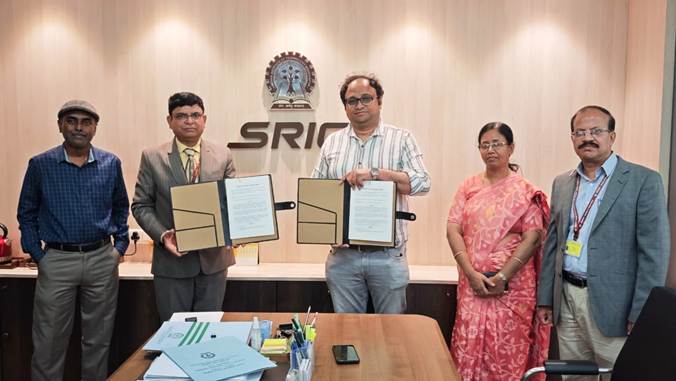
The MoU was signed on February 23, 2026, at IIT Kharagpur by Shri Kamal Kumar Agarwal, Deputy Director General (Finance & Administration), Telecommunication Engineering Centre, Department of Telecommunications, and Prof. Debdeep Mukhopadhyay, Associate Dean (Research and Development), IIT Kharagpur.
The signing took place in the presence of Prof. Suman Chakraborty, Director, IIT Kharagpur; Prof. Goutam Das; Dr. Debarati Sen; and Shri Souvick Kumar Das, Deputy Director General (Regional Telecommunication Engineering Centre), Telecommunication Engineering Centre.
The agreement provides a structured framework for close collaboration between TEC and IIT Kharagpur on next-generation telecom research and standardisation initiatives.
Areas of cooperation include exploration of 6G architecture and enabling technologies; joint R&D and standardisation of AI-enabled telecom systems, including EMF monitoring and smart IoT sensor solutions; research in advanced radio, antenna and massive MIMO technologies; and joint studies in satellite communication systems, NTNs, high-altitude platform systems (HAPS) and satellite–terrestrial integration, with a focus on disaster-resilient and emergency connectivity.
The partnership is expected to accelerate indigenous research and development and enhance India’s influence in global standardisation processes by strengthening contributions to international bodies such as the ITU. It also supports the Atmanirbhar Bharat vision by promoting home-grown research, design and manufacturing in the telecom sector, reducing import dependence and strengthening secure communications infrastructure.