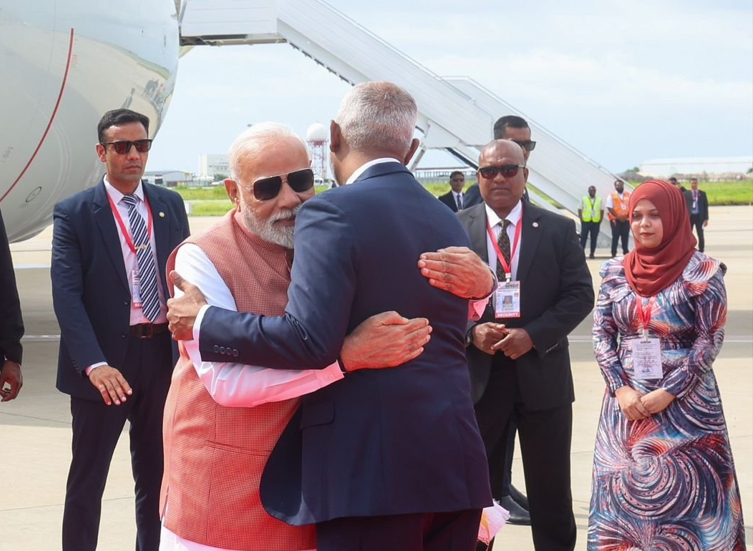
Prime Minister Narendra Modi’s ongoing visit to the Maldives on July 25, 2025, to participate in the nation’s Independence Day celebrations marks a historic milestone in diplomatic engagement. He holds the distinction of being the first head of government to visit the Indian Ocean archipelago under successive Maldivian administrations with starkly divergent foreign policy approaches. Notably, Modi was the only foreign leader invited to the inauguration of former President Ibrahim ‘Ibu’ Solih, a gesture underscoring India’s privileged ties with the Maldives. In contrast, his current visit under President Mohamed Muizzu, occurring 21 months into Muizzu’s tenure, makes him the first foreign head of state welcomed by this administration. Beyond the geopolitical and diplomatic weight of this visit, a profound and often overlooked dimension binds India and the Maldives: their shared linguistic heritage, a testament to centuries of cultural and historical ties between two nations.
Dhivehi: A linguistic bridge between India and Maldives
Dhivehi, the mother tongue of Maldives and a language that is spoken in parts of India’s Lakshadweep, is an Indo-Aryan language with roots that stretch back to the ancient subcontinent. Linguists trace its origins to Sanskrit and Prakrit, the classical languages that shaped many modern South Asian tongues. Dhivehi is one of the few Indo-Aryan languages spoken outside the Indian subcontinent, making it a linguistic outlier.. Its closest relative is Sinhala, the majority language of Sri Lanka, with which it shares a common ancestor in the Prakrit dialects spoken over 2,000 years ago. But Dhivehi didn’t stop at Indo-Aryan roots; it welcomed Dravidian influences from Tamil and Malayalam, language.
One of the most captivating aspects of Dhivehi is its script, Thaana. Unlike most Indo-Aryan languages that use Devanagari or related scripts, Thaana is unique, with its origins partially linked to Indian scripts like Grantha, used historically in South India for Sanskrit and Tamil. Thaana’s rounded, flowing characters, written right to left (a rarity among Indo-Aryan languages), are believed to have evolved from numerals and abbreviated forms of earlier scripts. The Thaana script’s name comes from the Arabic term “tāna,” meaning “song” or “melody,” reflecting its lyrical aesthetic.
Language as a Souvenir Shop
Dhivehi is a linguistic magpie that has borrowed words from Sanskrit, Prakrit, Tamil, Malayalam, and even Hindi, reflecting centuries of interaction with Indian traders, settlers, and travelers. The Dhivehi word for “king,” raajje, echoes the Sanskrit rājā, while dhoni, the traditional Maldivian boat, shares etymological roots with Tamil and Malayalam terms for small vessels. Everyday words like mas (fish) and kukulhu (chicken) mirror Tamil mīn and kōḻi, showcasing Dravidian influence. Dhivehi has borrowed from Hindi too, especially in modern times, thanks to Bollywood’s popularity in the Maldives. Words like filmu (film) and hero have slipped into everyday Dhivehi. Meanwhile, place names in the Maldives, such as Malé (the capital), may trace back to Sanskrit or Prakrit terms for “great” or “main,”. More examples include the Dhivehi word dharma (law or duty) that harks back to its Sanskrit roots, a reminder of the Buddhist monks who once chanted sutras on these shores.
As linguist Amalia E. Gnanadesikan notes, “Dhivehi is a language that carries the imprint of its South Asian heritage, with a core vocabulary and structure rooted in Indo-Aryan origins, enriched by centuries of contact with Dravidian languages like Tamil and Malayalam, as well as later influences from Arabic and other languages.” These words tell stories of ancient kings, coastal trade, and modern cultural exchanges.
Beyond language: the cultural crossroad
Dravidian influences, particularly from Tamil and Malayalam, entered through maritime trade. South Indian merchants from Kerala and Tamil Nadu sailed to the Maldives, trading spices, textiles, and ideas. These interactions introduced words and cultural practices, from culinary terms to boat-building techniques. Maldivian cuisine, with its coconut-rich curries and flatbreads like roshi (similar to Indian roti), mirrors South India’s coastal flavors. The traditional dance form Boduberu, with its rhythmic drumbeats, echoes Tamil folk music while incorporating African influences. Archaeological finds, such as 10th-century Buddhist inscriptions in the Maldives, further attest to India’s historical influence, linking the islands to the subcontinent’s spiritual and cultural legacy. These deep cultural exchanges not only shaped Maldivian traditions but also laid the foundation for the unique linguistic identity of Dhivehi, reflecting centuries of interaction and adaptation.
Dhivehi is more than a language, it’s a testament to the Maldives’ role as a maritime crossroads, where Indian influences from Sanskrit, Prakrit, Tamil, and Malayalam have woven a vibrant linguistic tapestry. From the Thaana script’s elegant curves to loanwords that carry the scent of Indian spices, Dhivehi tells a story of connection, resilience, and cultural fusion. As India and the Maldives continue to strengthen their bond, this shared linguistic heritage offers a bridge to a future of mutual understanding and development.