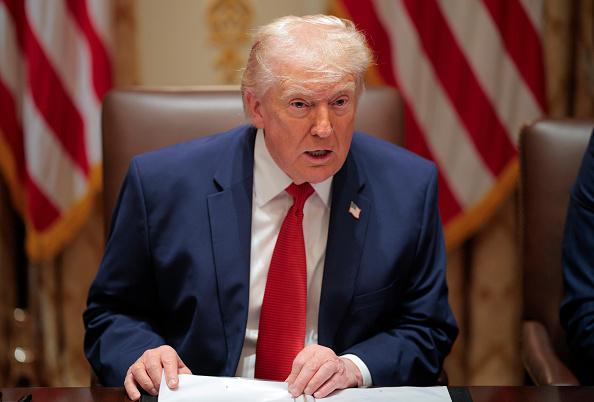
President Donald Trump said on Monday that a ceasefire with Iran was “on life support” after he rejected Tehran’s response to a U.S. peace proposal, fuelling concerns of a resumption of hostilities in the 10-week-old conflict that has killed thousands and halted vital energy flows.
Days after Washington floated a proposal aimed at reopening negotiations, Iran on Sunday released a response focused on ending the war on all fronts, including Lebanon, where U.S. ally Israel is fighting Iran-backed Hezbollah militants. The response had been swiftly rejected by Trump.
Asked where the ceasefire stands, Trump told reporters on Monday.
“I would call it the weakest right now, after reading that piece of garbage they sent us. I didn’t even finish reading it,” he said.
In its response, Tehran also demanded compensation for war damage, emphasised its sovereignty over the Strait of Hormuz, and called on the U.S. to end its naval blockade, guarantee no further attacks, lift sanctions and remove a ban on Iranian oil sales.
The U.S. had proposed an end to fighting before starting talks on more contentious issues, including Iran’s nuclear programme.
Tehran defended its stance on Monday.
“Our demand is legitimate: demanding an end to the war, lifting the (U.S.) blockade and piracy, and releasing Iranian assets that have been unjustly frozen in banks due to U.S. pressure,” Foreign Ministry spokesperson Esmaeil Baghaei said.
“Safe passage through the Strait of Hormuz and establishing security in the region and Lebanon were other demands of Iran, which are considered a generous and responsible offer.”
Brent crude oil futures traded 2.7% higher at around $104 a barrel, as the deadlock left the Strait of Hormuz largely closed. Before the war began on February 28, the narrow waterway carried one-fifth of the world’s oil and liquefied natural gas, and has since become a central pressure point in the conflict.
Disruption caused by the near-closure of the strait has forced oil producers to cut exports, and OPEC oil output dropped further in April to the lowest in more than two decades, a Reuters survey showed on Monday.
TRICKLE OF SHIPPING THROUGH HORMUZ
Traffic through the Strait of Hormuz is at a trickle compared with before the war. Shipping data on Kpler and LSEG showed that three tankers laden with crude exited the waterway last week, with trackers switched off to avoid Iranian attack.
A second Qatari LNG tanker was attempting to transit the strait, the data showed, days after the first such cargo crossed under an arrangement involving Iran and Pakistan.
Sporadic flare-ups around the strait in recent days have tested a ceasefire that has paused all-out warfare since it took effect in early April.
In the United States, surveys show the war is unpopular with voters facing sharply higher gasoline prices less than six months before nationwide elections that will determine whether Trump’s Republican Party retains control of Congress.
Washington has also struggled to build international support, with NATO allies refusing to send ships to reopen the waterway without a full peace deal and an internationally mandated mission.
Hakan Fidan, the foreign minister of Turkey, which has been liaising closely with the U.S., Iran and mediator Pakistan since the start of the war, will hold talks in Qatar on Tuesday on the conflict and on ensuring navigational safety in the strait, a Turkish diplomatic source said.
TRUMP SET TO DISCUSS IRAN IN BEIJING
The next diplomatic or military steps remain unclear. Trump is expected to arrive in Beijing on Wednesday, where Iran is set to be among the topics discussed with Chinese President Xi Jinping.
Trump has been leaning on China to use its influence to push Tehran toward a deal with Washington.
Iran’s Foreign Ministry spokesperson Baghaei suggested China could instead use the visit to push back against U.S. objectives in the Gulf. “Our Chinese friends know very well how to use these opportunities to warn about the consequences of the U.S.’ illegal and bullying actions on regional peace and security,” he said.
Addressing whether combat operations against Iran were over, Trump said in remarks aired on Sunday: “They are defeated, but that doesn’t mean they’re done.”
Israeli Prime Minister Benjamin Netanyahu said the war was not over because there was “more work to be done” to remove enriched uranium from Iran, dismantle enrichment facilities and address its proxy forces and ballistic missile capabilities.
Netanyahu told CBS News’ “60 Minutes” that the preferred route was diplomacy, but he did not rule out the use of force.
Clashes have also continued in southern Lebanon between Israel and Hezbollah, despite a U.S.-brokered ceasefire announced on April 16.
(Reuters)