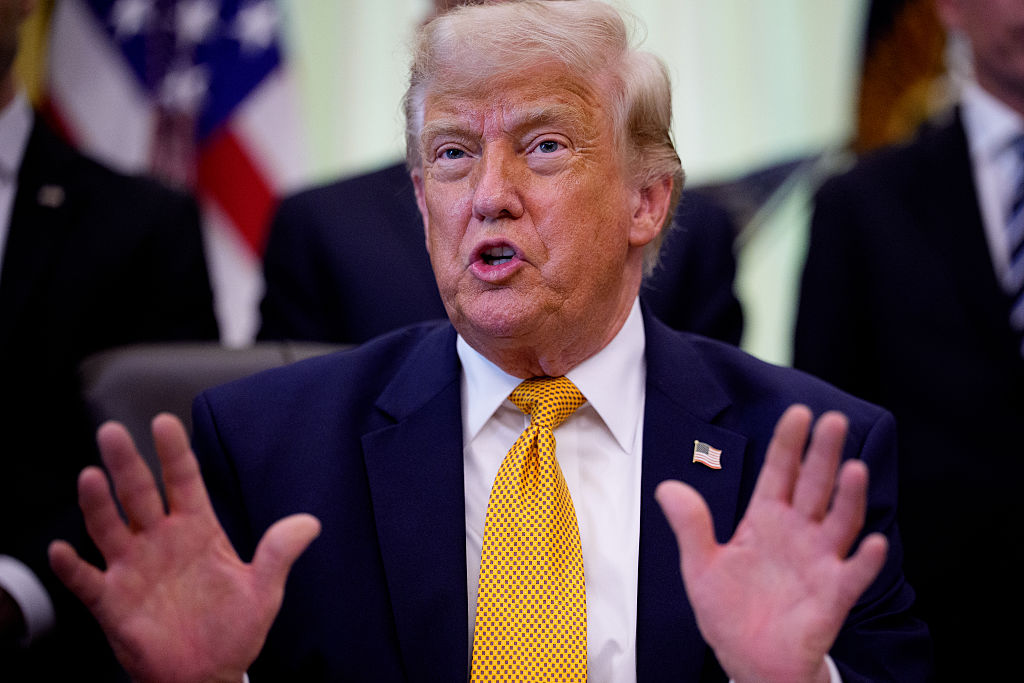
U.S. President Donald Trump on Monday ordered a push to build a powerful quantum computer for scientific research and speed efforts to protect government systems from related cyber threats, bolstering U.S. efforts in its race with China for a technology that could upend science and cybersecurity.
“We believe this can happen by 2028,” Michael Kratsios, director of the White House Office of Science and Technology Policy, said in a call previewing the moves and referring to the quantum computer.
Trump signed two executive orders, one of which seeks to protect government computers against quantum computer-fueled cyberattacks by setting a goal of migrating key government computing systems to post-quantum cryptography by 2030 or 2031.
Quantum computers use the laws of quantum physics to process information in ways that can solve certain complex problems far faster than even today’s supercomputers. They could unscramble the encryption that protects computers from hacking, raising fears of aggressive cyberattacks.
The orders underscore the importance the Trump administration places on securing U.S. leadership in the quantum race against China – which could fuel advances in artificial intelligence, materials science and chemistry – while also protecting against the cybersecurity threats posed by the technology.
The order also calls for the Pentagon to deploy quantum sensors by 2028. Such sensors can help aircraft navigate in war zones where global positioning systems have been disrupted and, when put in satellites, could also be used to detect underground activity such as the construction of tunnels or missile silos from space.
“There’s lots of interesting things quantum sensing can bring before quantum computing,” said Matthew Kinsella, CEO of Infleqtion, who attended the signing of the order in the Oval Office. “It’s possible to meet these types of timelines.”
Last month, the Commerce Department announced it would take $2 billion in equity stakes across nine quantum-computing companies, including a new IBM venture.
One of the orders also aims to strengthen international cooperation on intellectual property protections and supply chain security measures “in light of competitors and adversaries looking to undermine U.S. economic and national security,” Kratsios said.
Another measure included in the package instructs agencies to develop plans for deploying quantum-enabled sensors and networks in the next five years.
(Reuters)