






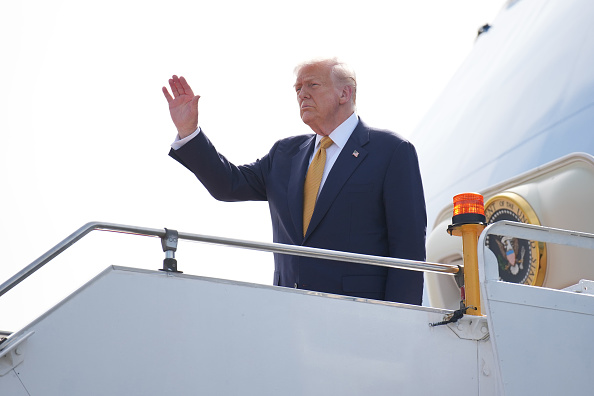
U.S. President Donald Trump will host the leaders of five Central Asian nations at the White House on Thursday as the U.S. seeks to gain influence in a region long dominated by Russia and increasingly courted by China.
The talks take place amid intensifying competition for Central Asia’s vast mineral resources. Western nations are seeking to diversify supply chains away from Moscow and Beijing. In particular, the U.S. is pursuing new partnerships to secure critical minerals, energy supplies, and overland trade routes that circumvent its geopolitical rivals.
Launched in 2015, the so-called C5+1 platform brings together the United States and the five Central Asian states — Kazakhstan, Kyrgyzstan, Tajikistan, Turkmenistan, and Uzbekistan — to advance cooperation on economic, energy and security issues. Their leaders will also attend a dinner with Trump at the White House on Thursday.
Gracelin Baskaran, a director at the Center for Strategic and International Studies, said the administration will pursue government-to-government engagement but also commercial deals that secure U.S. access to vital minerals.
“As China and Russia entrench their control over the region’s mining, processing, and infrastructure systems, Washington is seeking to establish a tangible foothold through targeted strategic projects,” Baskaran said.
Rich in minerals and energy, the five nations remain economically tied to Russia, their former Soviet ruler, while neighboring China has expanded its influence through large-scale infrastructure and mining investments.
Together, the countries are home to about 84 million people and hold vast deposits of uranium, copper, gold, rare earths and other strategic minerals essential to global efforts to transition to greener forms of energy.
Kazakhstan, the region’s largest economy led by President Kassym-Jomart Tokayev, is the world’s leading uranium supplier, producing nearly 40% of global output in 2024, while Uzbekistan ranks among the top five.
Together, they account for just over half of the world’s uranium production — a vital resource for U.S. nuclear power, a significant source of U.S. electricity. Russia still supplies roughly 20% of America’s imported uranium, making diversification an increasingly urgent goal.
Under Trump, the U.S. has pursued a multi-pronged strategy to secure critical minerals and reduce reliance on China, which dominates global supply chains for strategic metals including uranium, rare earth elements, copper, and titanium.
China at times has leveraged its dominance by restricting exports, underscoring Washington’s urgency to secure alternative sources.
(Reuters)