






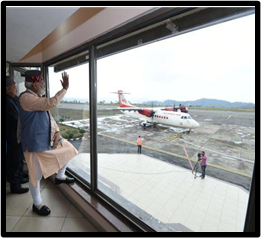
In a landmark initiative aimed at democratizing air travel, the Government of India launched the UDAN (Ude Desh ka Aam Nagrik) scheme on October 21, 2016, under the leadership of Prime Minister Narendra Modi. Implemented by the Ministry of Civil Aviation, the scheme seeks to make flying affordable and accessible for the common citizen, especially in Tier-2 and Tier-3 cities.
Rooted in Prime Minister Modi’s vision that even a common man in slippers should be able to afford air travel, UDAN has significantly reshaped India’s regional aviation landscape. The first UDAN flight, connecting Shimla and Delhi, took off on April 27, 2017, marking a milestone that will complete eight years on April 27.
Conceptualized under the National Civil Aviation Policy (NCAP) 2016 with a 10-year horizon, the scheme operates on a market-driven model supported by financial incentives such as Viability Gap Funding (VGF) and fare caps. It encourages collaboration between the Centre, State Governments, the Airports Authority of India (AAI), and private airport operators.
Under the UDAN framework, airlines receive financial support to maintain affordable fares, while airport operators waive landing and parking charges for RCS flights. The AAI exempts Terminal Navigation Landing Charges (TNLC) and applies discounted Route Navigation and Facilitation Charges (RNFC). Central and State Governments have also provided tax incentives and infrastructure support to bolster regional connectivity.
Since its inception, UDAN has expanded in multiple phases. UDAN 1.0 began in 2017 with 128 routes awarded, connecting 70 airports, including 36 newly operationalized ones. UDAN 2.0 in 2018 extended coverage to 73 underserved and unserved airports, including helipads. UDAN 3.0 in 2019 introduced tourism-specific routes and seaplane operations, with increased focus on the Northeast. UDAN 4.0 in 2020 targeted hilly regions and island territories, and enhanced helicopter and seaplane services.
The government has continued to innovate under the UDAN initiative. UDAN Yatri Cafes have been launched at Kolkata and Chennai airports to offer affordable food options to travelers. In August 2024, new guidelines were issued for seaplane operations, and UDAN Round 5.5 has been launched to invite bids for over 50 identified water bodies across the country.
A revamped version of the scheme aims to add 120 new destinations and enable affordable air travel for 4 crore more passengers over the next decade. The focus will be on expanding connectivity to remote, hilly, and aspirational districts, particularly in the Northeast, with special support for helipads and smaller airports.
The Krishi UDAN Scheme, designed to support the agricultural sector, facilitates cost-effective air logistics from Northeast, hilly, and tribal regions. It currently covers 58 airports, focusing on 25 priority airports and 33 others across India.
Looking ahead, the government has committed to developing 50 new airports over the next five years. This includes new greenfield airports in Bihar, expansion of Patna Airport, and development of a brownfield airport at Bihta to meet future demand and support regional growth.