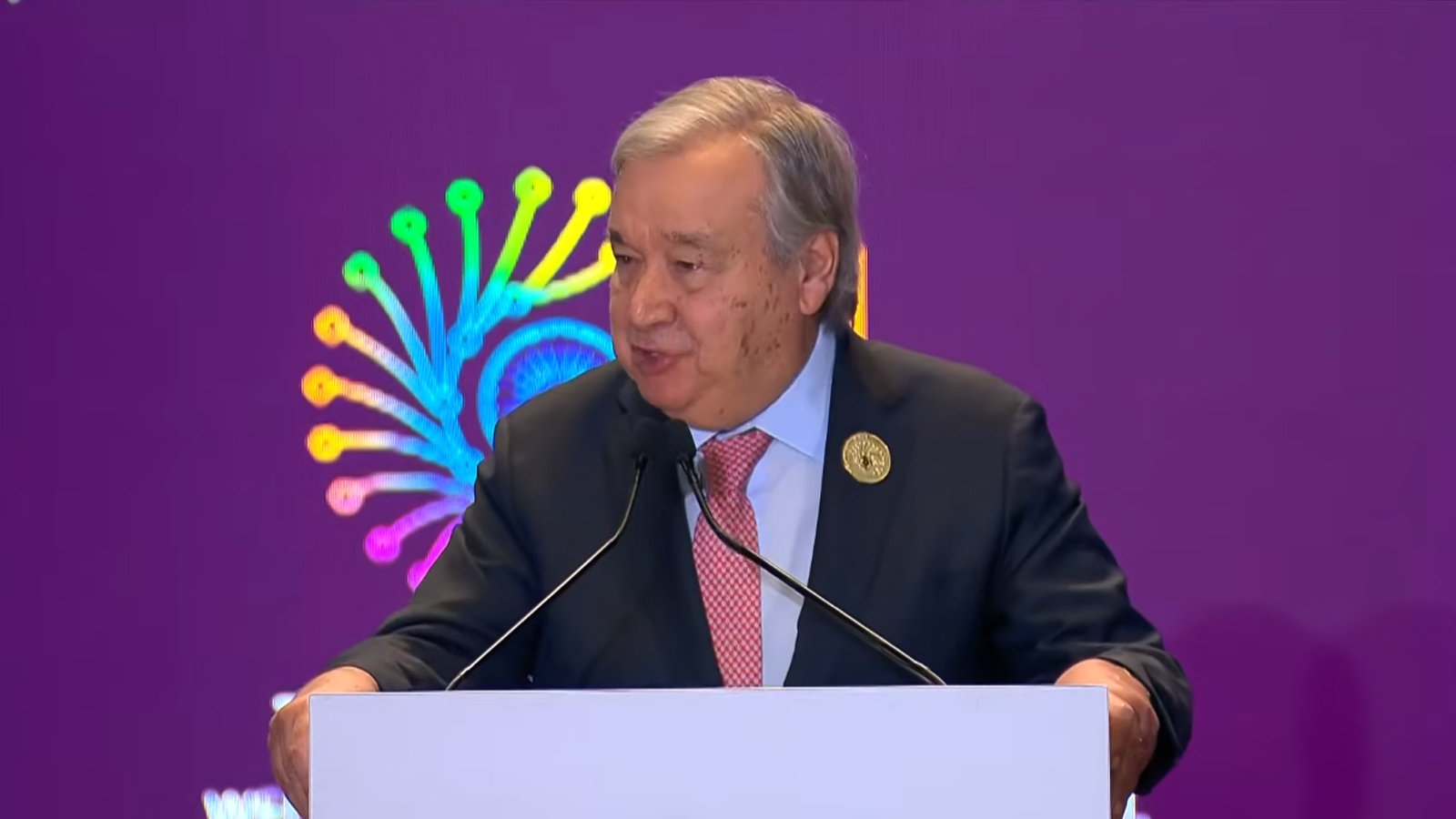
UN Secretary-General Antonio Guterres on Friday cited AI fragmentation risks, calling for global interoperability standards for better outcomes at the ‘India AI Impact Summit 2026’ here.
Guterres said that today, international cooperation is difficult. “Technological rivalry is growing. Without a common baseline, fragmentation wins, with different regions and different countries operating under incompatible policies and technical standards,” he warned.
Addressing the Summit, he said that when we agree on how to test systems and measure risk, we create interoperability.
“So a startup in New Delhi can scale globally with confidence because the benchmarks are shared and safety can travel with technology,” he noted.
Guterres also called for science-led AI guardrails to protect people and accelerate innovation.
“Once we understand what AI systems can do and what they cannot, we can move from rough measures to smarter, risk-based guardrails. Guardrails that protect people, uphold human rights, and preserve human agency,” he told the gathering.
According to the UN Secretary-General, AI guardrails must build confidence and give business clarity so innovation can move faster in the right direction.
“Science-led governance is not a brake on progress. It is an accelerator for solutions. It helps us identify where AI can do the most good and the fastest, and it helps us anticipate early impacts from risks for children to labour markets to manipulation at scale, so countries can prepare, protect, and invest in people,” he highlighted.
AI innovation is outpacing our collective ability to fully understand it — let alone govern it. If we want AI to serve humanity, policy cannot be built on guesswork, hype, or disinformation. We need facts we can trust and share across countries and sectors, he stressed.
According to him, AI must be accessible to everyone.
“But without investment, many countries will be logged out of the AI age. That’s why I am calling for a Global Fund on AI – to build skills, data, affordable computing power and inclusive ecosystems everywhere,” he added.
(IANS)