












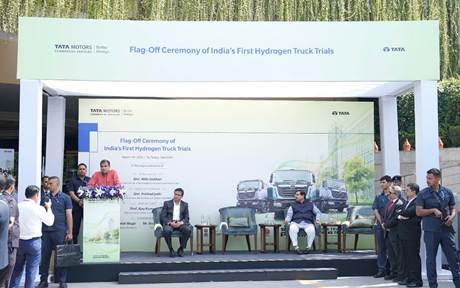
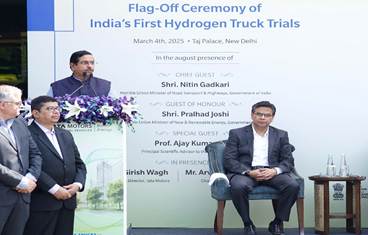
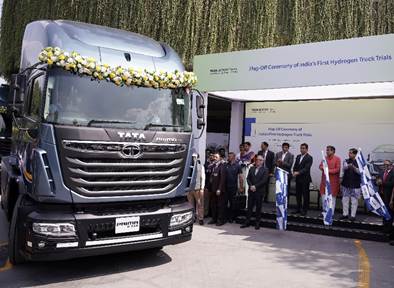
In a significant move toward India’s goal of achieving net-zero emissions by 2070, Union Ministers Nitin Gadkari and Pralhad Joshi on Tuesday launched the trial run of the country’s first fleet of hydrogen-powered trucks, developed by Tata Motors. This milestone represents a major advancement in India’s green energy transition, particularly in the transportation sector.
Union Minister of Road Transport and Highways, Nitin Gadkari, underscored hydrogen’s transformative potential in reducing emissions and boosting India’s energy self-reliance. He praised Tata Motors for leading the initiative, stating, “Hydrogen is the fuel of the future, accelerating the shift to sustainable heavy-duty trucking and driving us towards a low-carbon future.”
Union Minister for New and Renewable Energy, Pralhad Joshi, hailed the initiative as a key component of the National Green Hydrogen Mission (NGHM), emphasizing its importance in achieving energy independence and reducing carbon emissions. “This trial is a crucial step in demonstrating the role of green hydrogen in decarbonizing our transport sector,” he said.
The trials, which will span 24 months, will test 16 hydrogen-powered trucks equipped with Hydrogen Internal Combustion Engines (H2-ICE) and Fuel Cells (H2-FCEV) on major freight routes, including Mumbai, Pune, Delhi-NCR, and Surat. The aim is to assess the commercial viability of hydrogen-powered long-distance transportation. The fleet will be supported by hydrogen refuelling stations established by Indian Oil Corporation Limited (IOCL).
Girish Wagh, Executive Director of Tata Motors, reaffirmed the company’s commitment to pioneering clean mobility solutions. He expressed gratitude to the Indian government, saying, “We are proud to lead the transition to zero-emission long-haul transportation.”
Minister Joshi also highlighted India’s leadership in the global green energy transition under Prime Minister Narendra Modi. The National Green Hydrogen Mission, with an allocation of Rs.19,744 crore, positions India as a key player in hydrogen production, storage, and application. He noted significant progress, including the award of 4,12,000 TPA of Green Hydrogen production and 3 GW of electrolyser manufacturing capacity annually. Additionally, seven pilot projects have been launched across various sectors, along with the publication of 88 standards for safety and scalability.
Looking ahead, India’s 2030 targets include producing 5 million metric tons of Green Hydrogen annually, installing 60-100 GW of electrolyser capacity, and adding 125 GW of renewable energy dedicated to hydrogen production. These efforts are expected to cut 50 million metric tons of CO₂ emissions annually, save Rs.1 lakh crore in imports, and attract Rs.8 lakh crore in investments.












