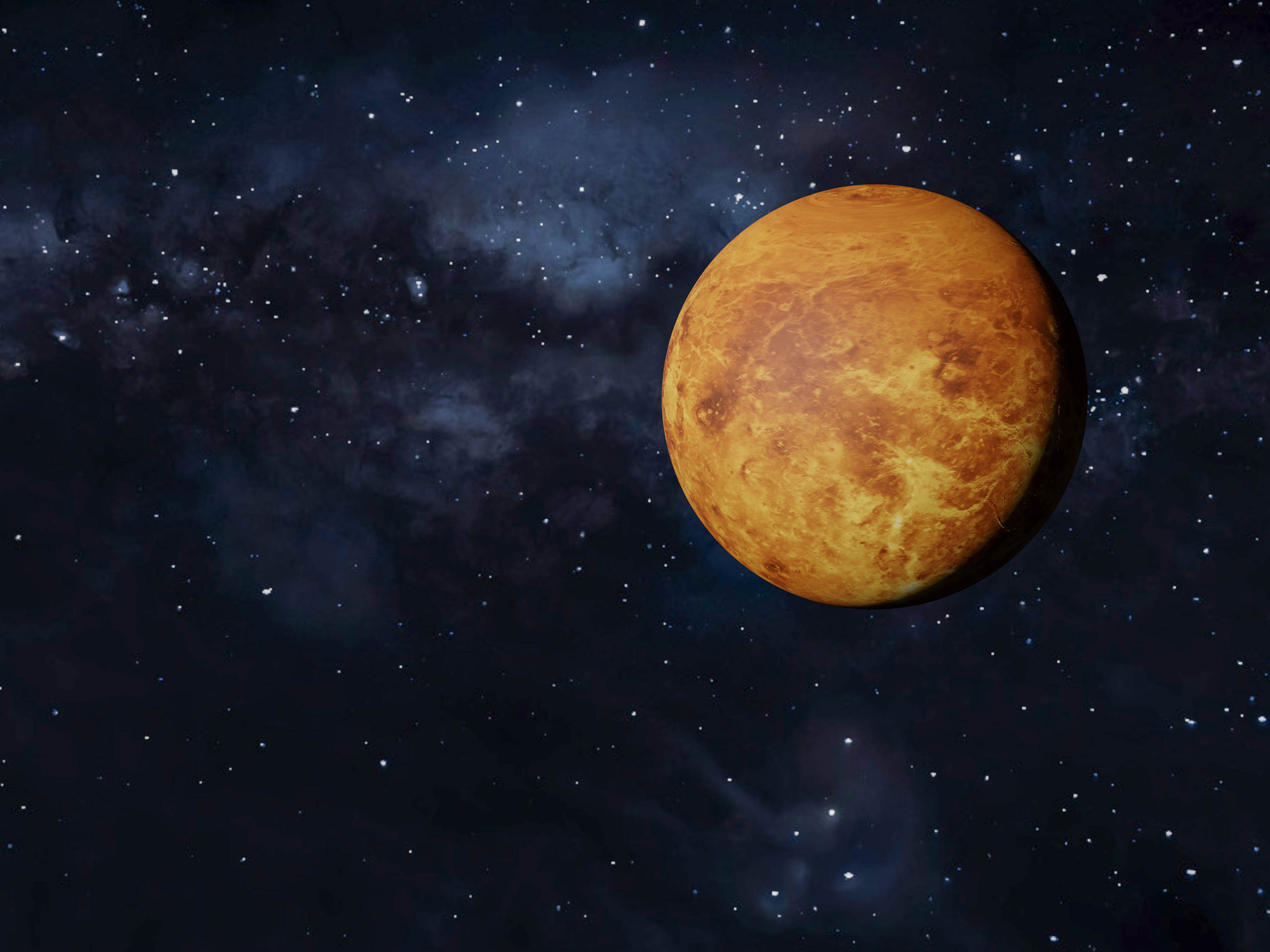
Venus appears to be more volcanically active than previously known, according to scientists whose new analysis of decades-old radar images has spotted evidence of eruptions at two additional sites on the surface of Earth’s inhospitable planetary neighbor.
Radar images obtained by NASA’s Magellan spacecraft from 1990 to 1992 indicated large lava flows at these two locations in the Venusian northern hemisphere at the time of the observations, the researchers said. These findings, coupled with previous studies, indicate that the planet’s volcanic activity is comparable to Earth’s, they added.
Magellan mapped 98% of the Venusian surface. Advances in computing capability have made analyzing Magellan’s radar data easier in recent years.
“These findings significantly change our understanding of the degree to which Venus is volcanically active, suggesting it could be much more active than previously thought,” said planetary scientist Davide Sulcanese of d’Annunzio University in Pescara, Italy, lead author of the study published this week in the journal Nature Astronomy.
One of the two sites is a volcano called Sif Mons, which is about 200 miles (300 km) wide and situated in a region called Eistla Regio. The before-and-after radar images indicate a lava flow amounting to about 12 square miles (30 square km) of rock. The other site is a large volcanic plain in a region called Niobe Planitia. About 17 square miles (45 square kilometers) of rock was produced in this lava flow.
“Both Sif Mons and the volcanoes in Niobe Planitia are shield volcanoes, characterized by broad, gentle slopes formed by low-viscosity lava flows,” said d’Annunzio University planetary scientist and study co-author Giuseppe Mitri.
The new rock at both locations was estimated to have an average depth between about 10 and 66 feet (three and 20 meters).
“The lava flows observed along the western flank of Sif Mons exhibit linear features with sinuous patterns that follow the direction of the maximum slope, generally towards the west,” said planetary scientist and study co-author Marco Mastrogiuseppe of University Sapienza in Rome and Link Campus University in Rome.
“Regarding the flows in Niobe Planitia, the lava flows appear to originate near small shield volcanoes and extend towards the northeast, also following the direction of the slope,” Mastrogiuseppe added.
Venus is the second planet from the sun, and Earth the third. Venus has a diameter of about 7,500 miles (12,000 km), slightly smaller than Earth.
The new study builds on previous findings of ongoing Venusian volcanic activity. A 2023 study found that a volcanic vent on Maat Mons in a region called Atla Regio, near the equator, expanded and changed shape during the Magellan mission.
“Our study is the first to provide direct proof of lava flows formed during the Magellan mission period. By analyzing radar images from the Magellan spacecraft, we observed changes in surface morphology and radar data indicative of new lava flows,” Sulcanese said.
“This offers direct evidence of ongoing volcanic activity on Venus, building upon previous evidence such as atmospheric sulfur dioxide variations, surface thermal emissions data, and especially the evidence of deformation of a volcanic vent observed in Atla Regio,” Sulcanese said.
Studying volcanic activity provides a fuller understanding of a planet’s internal heat and geological processes.
“It provides insights into the planet’s thermal evolution, surface renewal processes and atmospheric interactions,” Mitri said.
The thick Venusian atmosphere, mainly carbon dioxide, traps in heat in a runaway greenhouse effect, making Venus our solar system’s hottest planet.
“Despite Venus and Earth being very similar in terms of size, mass, chemical composition and internal structure, there are fundamental differences that make Venus an infernal planet,” with a roasting surface temperature and crushing atmospheric pressure, Sulcanese said.
“The reason for this different evolution is still a subject of debate,” Sulcanese added, noting that planned NASA and European Space Agency missions in the coming years “will help us better understand why these two planets have met such different fates.”
(Reuters)