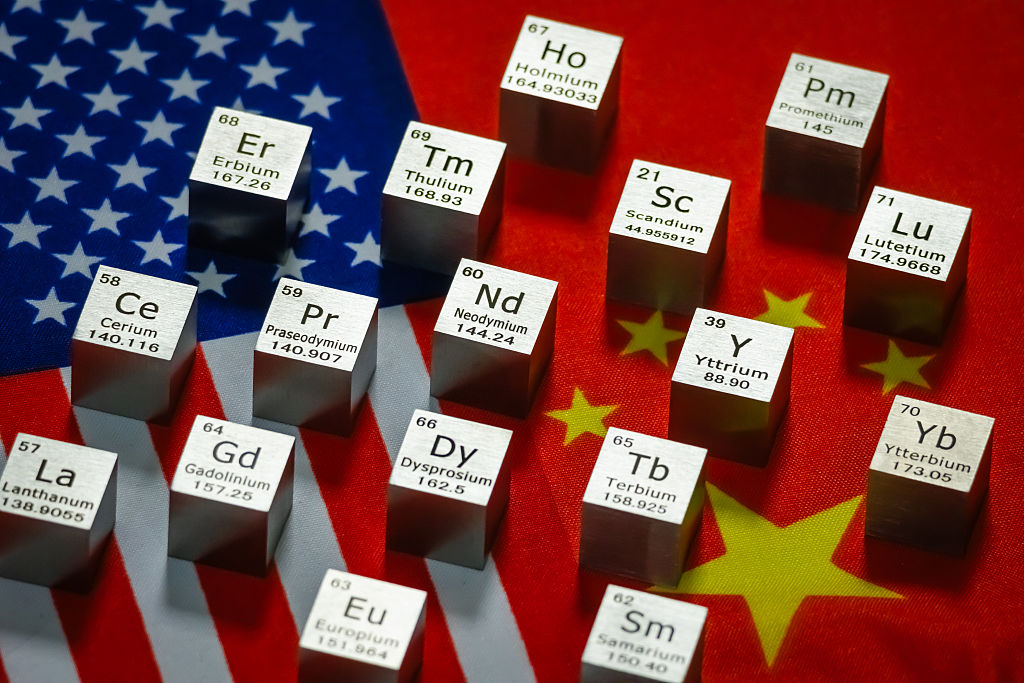
U.S. President Donald Trump and his Chinese counterpart Xi Jinping have wrapped up a summit in South Korea with a deal to keep Chinese rare earth exports flowing.
Here are some basic facts about these obscure elements making headlines around the world:
WHAT ARE THEY?
Rare earths are a group of 17 elements including 15 silvery-white metals called lanthanides, or lanthanoids, plus scandium and yttrium.
WHAT ARE THEY USED FOR?
Rare earths or the magnets which they are sometimes made into can be found in small but important quantities in everything from iPhones and washing machines to the F35 fighter jet.They are also used in electric vehicles (EVs), medical equipment, oil refining, and other military applications such as missiles and radar systems.
Without them, supply chains quickly grind to a halt. Automakers were forced to paused some production earlier this year after Chinese export controls caused shortages.
ARE THEY RARE?
They are not rare in the sense that they are uncommon; some are more common than lead, for example. But they tend to be spread thin around the Earth’s crust in small quantities and mixed together or with other minerals, so larger deposits are difficult to find and costly to extract.
WHAT COUNTRY IS THE BIGGEST PRODUCER?
While U.S. scientists helped developed a process to separate and refine rare earths in the 1950s, China since the 1980s has come to dominate the industry thanks to lower costs, laxer environmental standards and decades of government support.
China accounts for about 60% of global mine production and 90% or more of refined production and rare earth magnet output.
Projects are under way across the U.S., Europe, and Australia to build an alternative supply chain but it will take years to produce meaningful quantities.
In the meantime, China is restricting exports of an increasing number of the elements and the equipment needed to mine and refine them.
WHAT ARE THEIR NAMES?
In their periodic table order, they are: scandium, yttrium, lanthanum, cerium, praseodymium, neodymium, promethium, samarium, europium, gadolinium, terbium, dysprosium, holmium, erbium, thulium, ytterbium, and lutetium.
WHAT ENVIRONMENTAL IMPACT DO THEY HAVE?
Processing rare earths often involves the use of solvents, which can produce toxic waste that pollutes the soil, water, and atmosphere. More environmentally friendly technologies are being developed, but they are not yet widely used.
Certain types of rare earth ores also contain radioactive thorium or uranium, which is often removed using acid.
For this reason, development of the sector faces health and environmental regulatory hurdles.
-Reuters