Latin American leaders on Monday rallied to Panama’s defense after U.S. President-elect Donald Trump threatened to reimpose U.S. control over the Panama Canal, a key global shipping route located in the Central American nation.
WHAT IS THE PANAMA CANAL?
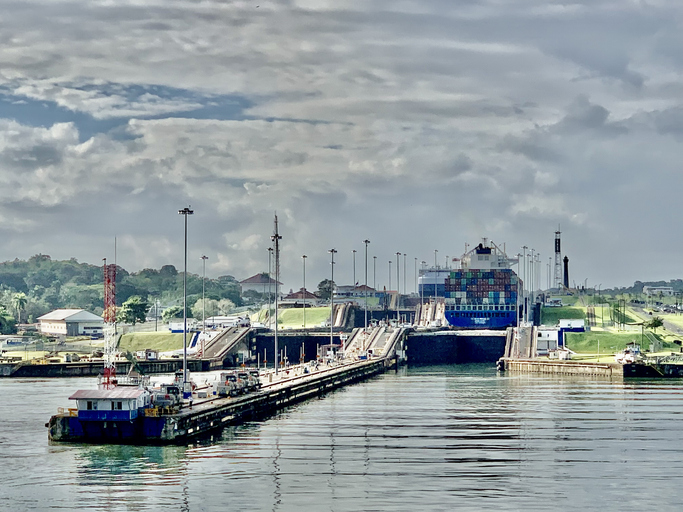
The Panama Canal is an 82-km (51-mile) artificial waterway that connects the Pacific and Atlantic Oceans through Panama, saving ships thousands of miles and weeks of travel around the stormy, icy southern tip of South America.
The journey for ships traveling from Los Angeles to New York is close to 8,000 miles (around 22 days) shorter via the canal compared to traveling through the Strait of Magellan off Tierra del Fuego, an archipelago that embraces southern Chile and Argentina.
The canal transports ships through the Gatun Lake, some 26 meters (85 ft) above sea level, via a series of interconnecting locks. Each ship’s transit requires some 200 million liters (53 million gallons) of fresh water.
BUILDING THE CANAL
Spanish colonizers began studying the construction of an inter-oceanic canal cutting through the isthmus at its narrowest point, in southern Central America, as early as the 1530s. But it was not until 1878 that Colombia – which then counted Panama as a province – signed a concession with French engineers.
The French effort was ultimately a failure, going bankrupt in 1899. Around 22,000 workers lost their lives on the project, many from disease and accidents.
In 1903 the U.S. sought a permanent concession for a canal from Colombia, which rejected the proposal. In response, the U.S. supported Panama’s independence, which was declared on Nov. 3.
Three days later, Panama’s ambassador to Washington signed a treaty granting the U.S. rights to build and indefinitely administer the canal. The U.S. paid Panama $10 million and later a $250,000 annuity for the rights. Many Panamanians condemned the treaty as an infringement on their newfound sovereignty.
The U.S. construction was largely carried out by Afro-Panamanian and Caribbean workers, over 5,000 of whom died before the canal finally opened in 1914.
THE HANDOVER
During the 20th century, U.S.-Panama tensions worsened and there were growing protests against U.S. control of the canal, notably after the Suez Canal crisis in 1956, when British and French plans to invade Egypt after it nationalized the Suez Canal were halted after U.S. pressure.
In 1977, President Jimmy Carter signed a treaty with Panamanian military leader Omar Torrijos that granted Panama free control over the canal and guaranteed the waterway’s permanent neutrality.
This took effect on Dec. 31, 1999. The canal has since been administered by the Panamanian government’s Panama Canal Authority, and remains a key source of income for the country.
RECENT DEVELOPMENTS
Climate change has contributed to increasing droughts that have impacted water levels in the lakes feeding the canal, forcing the canal authority to limit transits as it balances Panamanians’ water needs.
On Sunday, Trump threatened to reimpose U.S. control, citing what he said were excessive fees to use the canal and a risk of Chinese influence. A subsidiary of Hong Kong-based CK Hutchison Holdings has long managed two ports near canal entrances.
“It was given to Panama and the people of Panama, but it has provisions,” Trump said of the canal.
“If the principles, both moral and legal, of this magnanimous gesture of giving are not followed, then we will demand that the Panama Canal be returned to us, in full, quickly and without question.”
PANAMA’S RESPONSE
Panamanian President Jose Raul Mulino rejected Trump’s threat. He said the canal’s tariffs were carefully and transparently evaluated, and that these maintain the canal and helped expand it in 2016, boosting traffic and global trade.
“Every square meter of the Panama Canal and its surrounding area belongs to Panama and will continue to do so,” he said in a statement on Sunday. “Our country’s sovereignty and independence are not negotiable.”
“The canal is not under any direct or indirect control from China, the European community, the United States, or any other power,” Mulino added.
(Reuters)