







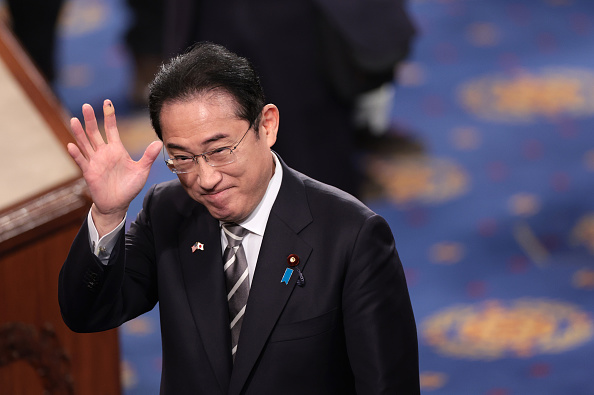
Japanese Prime Minister Fumio Kishida said on Wednesday he would step down next month, a move that sets off a scramble among would-be successors to replace him as head of the world’s fourth-largest economy.
Click here for a rundown of likely candidates aiming to aiming to succeed Kishida as Japan’s premier.
WHY IS KISHIDA STEPPING DOWN?
Kishida has been prime minister for almost three years, a relatively long tenure in modern Japanese politics. Yet his administration had become unpopular due to a slush fund scandal and controversy over the ruling party’s connection to the former Unification Church.
The economy also hurt his popularity. Households were battered as price increases outpaced pay rises.
For months, public support for Kishida and his cabinet languished below the 30% in opinion polls that is typically seen as a trigger for new elections or leadership change.
WHAT HAPPENS NEXT?
Under Japan’s parliamentary system, the leader of the ruling party, or coalition of parties, becomes prime minister. For almost all of Japan’s post-World War II history, that has meant the premier has hailed from Kishida’s Liberal Democratic Party (LDP).
The LDP must hold a leadership race every three years. The next one is due to be held in September although the dates have yet to be set.
WHO COULD SUCCEED KISHIDA?
Candidates need 20 signatures from LDP parliamentarians to run for leadership of the party. Former Defence Minister Shigeru Ishiba and former Foreign Minister Toshimitsu Motegi are among those seen as frontrunners.
Political factions are a critical force in LDP leadership contests, with former prime ministers Taro Aso, Yoshihide Suga and Kishida himself seen as potential kingmakers.
HOW DOES THE VOTE WORK?
Each LDP member of parliament will get a vote, and a similar number of votes will be apportioned among rank-and-file members of the party at large.
The LDP currently has 369 lawmakers in the upper and lower houses of parliament, based on the party’s website, while registered party members numbered about 1.13 million during the previous election in 2021.
The votes cast by party members will be tallied according to a proportional representation system called the D’Hondt method.
If no one wins a majority of the votes in the first round, there will be a run-off vote between the top two candidates.
HOW WILL THE NEXT ADMINISTRATION BE FORMED?
Once a new LDP leader is elected, parliament will be called into session to elect the next prime minister. The candidate who wins the majority of votes cast by the lower and upper houses of parliament will take the top job.
Given the LDP’s majority in both houses, the LDP leader will likely be elected as prime minister. The new premier is also expected to form a new cabinet and reshuffle the LDP party executives in early October.
(Reuters)