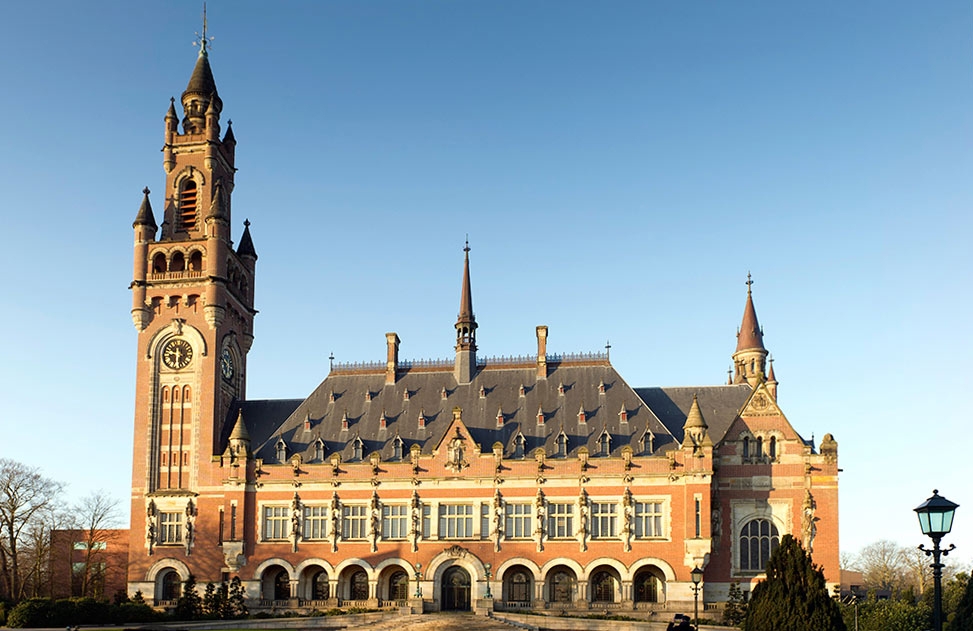
The United Nations’ highest court will deliver an opinion on Wednesday that is likely to determine the course of future climate action across the world.
Known as an advisory opinion, the deliberation of the 15 judges of the International Court of Justice (ICJ) in The Hague is legally non-binding. It nevertheless carries legal and political weight and future climate cases would be unable to ignore it, legal experts say.
“The advisory opinion is probably the most consequential in the history of the court because it clarifies international law obligations to avoid catastrophic harm that would imperil the survival of humankind,” said Payam Akhavan, an international law professor.
In two weeks of hearings last December at the ICJ, also known as the World Court, Akhavan represented low-lying, small island states that face an existential threat from rising sea levels.
In all, over a hundred states and international organisations gave their views on the two questions the U.N. General Assembly had asked the judges to consider.
They were: what are countries’ obligations under international law to protect the climate from greenhouse gas emissions; and what are the legal consequences for countries that harm the climate system?
Wealthy countries of the Global North told the judges that existing climate treaties, including the 2015 Paris Agreement, which are largely non-binding, should be the basis for deciding their responsibilities.
Developing nations and small island states argued for stronger measures, in some cases legally binding, to curb emissions and for the biggest emitters of climate-warming greenhouse gases to provide financial aid.
PARIS AGREEMENT AND AN UPSURGE IN LITIGATION
In 2015, at the conclusion of U.N. talks in Paris, more than 190 countries committed to pursue efforts to limit global warming to 1.5 degrees Celsius (2.7 degrees Fahrenheit).
The agreement has failed to curb the growth of global greenhouse gas emissions.
Late last year, in the most recent “Emissions Gap Report,” which takes stock of countries’ promises to tackle climate change compared with what is needed, the U.N said that current climate policies will result in global warming of more than 3 C (5.4 F) above pre-industrial levels by 2100.
As campaigners seek to hold companies and governments to account, climate‑related litigation has intensified, with nearly 3,000 cases filed across almost 60 countries, according to June figures from London’s Grantham Research Institute on Climate Change and the Environment.
So far, the results have been mixed.
A German court in May threw out a case between a Peruvian farmer and German energy giant RWE, but his lawyers and environmentalists said the case, which dragged on for a decade, was a still victory for climate cases that could spur similar lawsuits.
Earlier this month, the Inter-American Court of Human Rights, which holds jurisdiction over 20 Latin American and Caribbean countries, said in another advisory opinion its members must cooperate to tackle climate change.
Campaigners say Wednesday’s court opinion should be a turning point and that, even if the ruling itself is advisory, it should provide for the determination that U.N. member states have broken the international law they have signed up to uphold.
“The court can affirm that climate inaction, especially by major emitters, is not merely a policy failure but a breach of international law,” said Fijian Vishal Prasad, one of the law students that lobbied the government of Vanuatu in the South Pacific Ocean to bring the case to the ICJ.
Although it is theoretically possible to ignore an ICJ ruling, lawyers say countries are typically reluctant to do so.
“This opinion is applying binding international law, which countries have already committed to. National and regional courts will be looking to this opinion as a persuasive authority and this will inform judgments with binding consequences under their own legal systems,” Joie Chowdhury, senior attorney at the Center for International Environmental Law, said.
The court will start reading out its opinion at 3 p.m. (1300 GMT).
(Reuters)