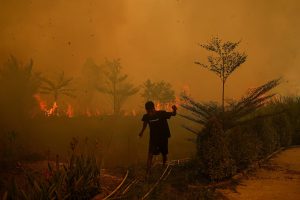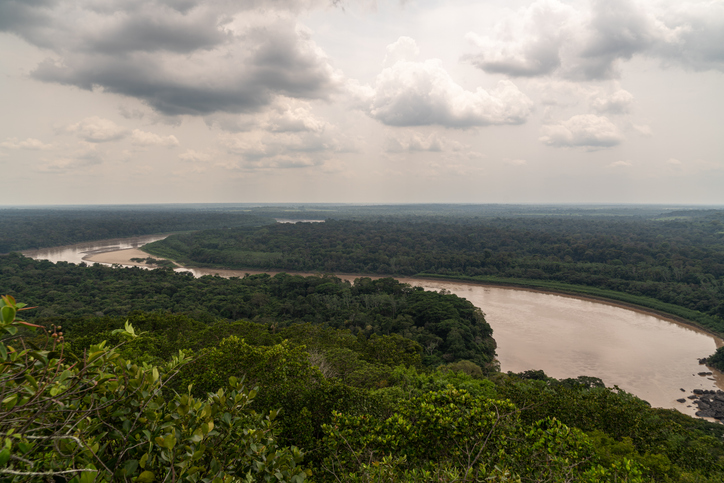
Forests and other land ecosystems failed to curb climate change in 2023 as intense drought in the Amazon rainforest and record wildfires in Canada hampered their natural ability to absorb carbon dioxide, according to a study presented on Monday.
That means a record amount of carbon dioxide entered Earth’s atmosphere last year, further feeding global warming, the researchers said.
Plant life helps to slow climate change by taking in huge amounts of carbon dioxide, the main greenhouse gas driving global warming. Forests and other land ecosystems on average absorb nearly a third of annual emissions from fossil fuels, industry and other human causes.
But in 2023, that carbon sink collapsed, according to study co-author Philippe Ciais of the Laboratory for Climate and Environmental Sciences (LSCE), a French research organization.
“The sink is a pump, and we are pumping less carbon from the atmosphere into the land,” Ciais said in an interview. “Suddenly the pump is choking, and it’s pumping less.”
As a result, the growth rate of carbon dioxide in the atmosphere jumped 86% in 2023 compared to 2022, the researchers said.
Scientists at Tsinghua University in China, the University of Exeter in England and LSCE led the research into what caused the shift. Their study was presented at the International Carbon Dioxide Conference in Manaus, Brazil.
A major driver was record high temperatures globally that dried out vegetation in the Amazon and other rainforests, preventing them from taking up more carbon while also fueling record fires in Canada, the study found.
“Imagine your plants at home: If you don’t water them, they’re not very productive, they don’t grow, they don’t take up carbon,” said Stephen Sitch, a study co-author and carbon expert at the University of Exeter.
“Put that on a big scale like the Amazon forest,” Sitch told Reuters on the sidelines of the conference
The study is still in the process of peer review with an academic journal, but three scientists who were not involved in the research told Reuters that its conclusions were sound.
They said that dips in land carbon sinks tend to happen in years affected by the El Nino climate phenomenon, like 2023. But the record high temperatures being driven by climate change made last year’s dip particularly extreme.
Also, the consequences of the dip are more severe than in the past because humans are now causing the emission of more carbon dioxide than ever before.
The scientists cautioned that Earth’s carbon sink varies widely year to year, and a single year alone will not spell doom. But it would be alarming if what was observed in 2023 becomes a trend, they added.
“This is a warning,” said Richard Birdsey of Woodwell Climate Research Center in the United States, who was not involved in the study. “There’s a good chance that years like 2023 are going to be more common.”
The less carbon the land ecosystems absorb, the less fossil fuels the world can burn before humankind blows past global climate targets, said Anthony Walker, an ecosystem modeler at the Oak Ridge National Laboratory in the United States who was not involved in the study.
“We cannot count on ecosystems to bail us out in the future,” said Trevor Keenan, an ecosystem scientist at University of California, Berkeley who was not involved in the study.
(Reuters)