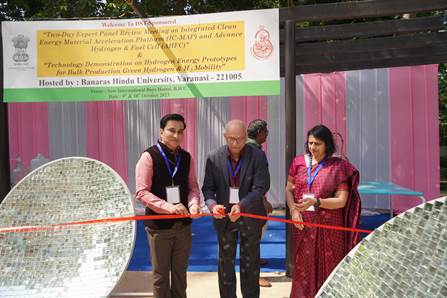
Innovative quantum technology was unveiled recently that has potential to revolutionize green hydrogen production on a massive scale. Developed by the Green Keplerate Team at Banaras Hindu University (BHU), this innovation promises to enhance the production of green hydrogen.
In a ceremony at BHU in Varanasi, Dr. Anita Gupta, the Head of The Climate Change (CC) at the Department of Science and Technology (DST) Ranjith Krishna Pai, a Scientist and Director of the CC at DST, and Prof. R. R. Sonde, chairman of the expert committee at IIT Delhi, inaugurated this pioneering technology. The event saw the presence of distinguished experts from various domains from all corners of the country.
The masterminds behind this transformative technology, Dr. Somenath Garai and S. Srikrishna presented the numerous environmentally friendly applications of Green Hydrogen and the new innovation of introducing a next-generation quantum-powered featuring a charge transfer system, and high proton availability and mobility, to drive quantum catalytic processes for energy generation.
This revolutionary technology, developed under the project titled “Boosting the H2 Economy by Harnessing the Merits of Quantum Encapsulation Chemistry:
The Hydrogen and Fuel Cell program in the Clean Energy Research Initiative is currently awaiting patent approval. The photochemical reactor's state-of-the-art design includes an integrated illumination assembly and external concave reflective panels that maximize the utilization of solar energy. The team ingeniously engineered a continuous electron-coupled proton supply system, incorporating an electron injector mechanism that utilizes industrial metal waste. After rigorous optimization, the team achieved an impressive production rate of approximately 1 liter per minute of Green Hydrogen for every 10 grams of Quantum Photocatalysts at the laboratory scale.
The high purity of the hydrogen gas produced can be used directly without the need for additional purification. This feature significantly enhances the cost-effectiveness of this revolutionary technology. This innovation opens up a wealth of possibilities, spanning various sectors, including energy production, transportation, and agriculture.
The Green Keplerate Team envisions the potential of storage-free, direct hydrogen internal combustion engine technologies and has already demonstrated its applicability in automobiles with a range of engine capacities and functionalities. This ongoing project, funded by DST, promises to bring these innovations to the forefront of the green energy revolution.